
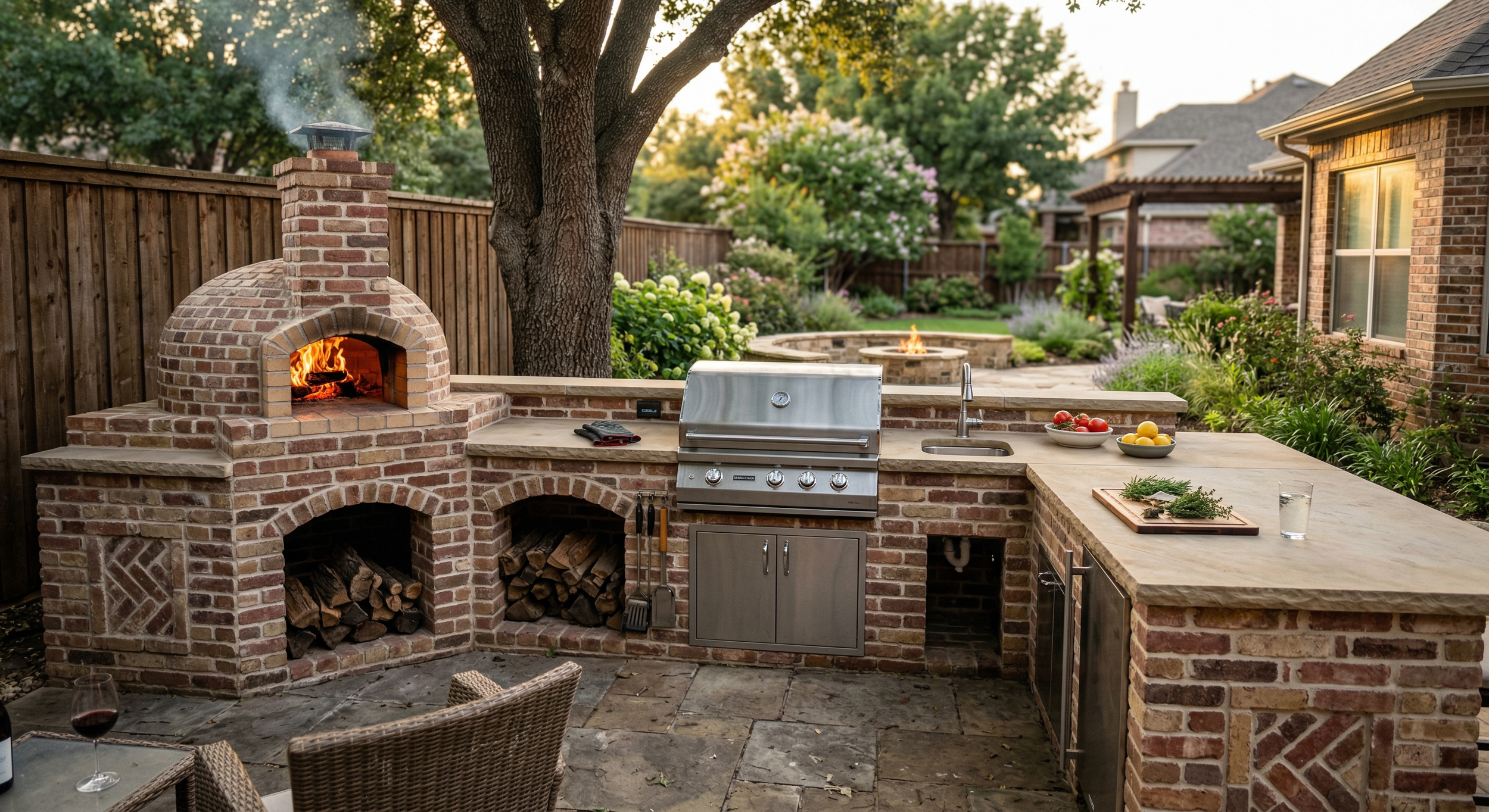
How Much Does a Masonry Outdoor Kitchen Cost? Licensed Mason Pricing Breakdown
By Brick & Stone Master | Updated for 2026 | Dallas-Fort Worth, TX
It's a perfect March evening in Grapevine. The temperature has dropped to a comfortable 68 degrees, the kind of night that reminds you why you moved to North Texas in the first place. You're standing in your backyard imagining it: a custom masonry outdoor kitchen where friends gather around a built-in grill, where the smell of smoked brisket drifts across the patio, where your home becomes the place everyone wants to be. The vision is clear. Then reality sets in. How much is this actually going to cost? What's included in that number? How do I find a mason I can trust? Those are exactly the right questions — and this guide is here to answer all of them.
Key Takeaways
- Entry-level masonry outdoor kitchens in DFW run $8,000–$15,000; mid-range projects cost $15,000–$35,000; premium custom builds reach $35,000–$75,000+
- DFW's expansive clay soils require an engineered concrete foundation — this is non-negotiable and costs $1,000–$5,000+
- Budget an additional 20–30% beyond the quoted masonry price for permits, gas lines, electrical, plumbing, and site prep
- Texas does not license masons directly, but gas, electrical, and plumbing work must be performed by TDLR-licensed professionals
- All DFW cities require permits for outdoor kitchens — any contractor who says otherwise is a red flag
- Scheduling your build in late fall or winter (November–January) can save 5–10% on labor costs
- A properly built masonry outdoor kitchen can last 50+ years and adds measurable resale value in the DFW market
- The 5-year true cost of ownership for a mid-range kitchen is approximately $28,000–$29,500 including maintenance
You're Not Alone in Wondering About Cost
Outdoor kitchens are a significant investment, and it's completely normal to feel uncertain about pricing, hidden costs, and whether it's worth the money. The good news: with the right information and the right contractor, you can make a confident decision that aligns with your budget and lifestyle. That's exactly what this guide is designed to help you do.
Why DFW Homeowners Are Investing in Masonry Outdoor Kitchens Right Now
If you're considering a masonry outdoor kitchen in 2026, you're in very good company. The Dallas-Fort Worth metroplex has become one of the most active markets in the country for premium outdoor living, and there are real, tangible reasons why — not just trends or marketing hype.
Start with the climate. DFW enjoys an outdoor season that stretches roughly 8 to 9 months, from March through November. That's not a backyard amenity — that's a functional extension of your living space for the better part of the year. Compare that to homeowners in Chicago or Minneapolis who might get four months of comfortable outdoor weather, and you start to understand why Texans invest so heavily in outdoor living infrastructure.
The economic profile of the region supports this investment too. Denton County — home to communities like Roanoke, Flower Mound, and Argyle — reports median household incomes of approximately $105,000–$110,000, with homeownership rates of 70–75%. These are households with equity, disposable income, and a strong motivation to improve the properties they own. Tarrant County follows closely with median incomes around $85,000–$90,000. When you combine those demographics with DFW's strong real estate market, outdoor kitchens shift from luxury to smart investment.
The post-pandemic shift toward home-centered living has also proven remarkably durable. What began as a necessity in 2020 became a lifestyle preference that continues strong through 2026. DFW homeowners who invested in their outdoor spaces during that period discovered something: the backyard, when properly designed, becomes the most-used room in the house. That discovery has driven a new wave of investment from neighbors who watched those transformations happen and want the same for their own properties.
There's also the Texas culture factor that's hard to quantify but impossible to ignore. Outdoor entertaining, barbecue traditions, and the social ritual of gathering around a grill are deeply embedded in North Texas life. A masonry outdoor kitchen isn't just a cooking station — it's a gathering place that fits naturally into how people here actually live. Whether you're in Southlake, Colleyville, or a newer master-planned community in Frisco, the demand for functional, beautiful outdoor spaces continues to grow.
Real estate professionals across DFW consistently report that homes with well-designed outdoor kitchens sell faster and command premiums compared to comparable properties without them. For homeowners who plan to stay long-term, the lifestyle value is obvious. For those who may eventually sell, it's an investment that tends to pay back. Understanding masonry repairs and long-term maintenance from the start is part of protecting that investment over time.
Masonry Outdoor Kitchen Cost Breakdown: Entry-Level to Premium (2026)
Let's get to the numbers. One of the most frustrating things about researching outdoor kitchen costs online is the vagueness — you find ranges so wide they're essentially useless. The reality is that pricing depends heavily on scope, materials, and local market conditions. Here's what you can realistically expect to pay in the DFW market in 2026, broken down by project tier.
Before diving in, one important note: these ranges reflect the masonry build and core components. Permits, gas line extensions, electrical runs, plumbing, and the concrete foundation are often quoted separately — we'll cover those hidden costs in detail in the next section. For now, think of these as your baseline build costs for custom stone and brick masonry work on the outdoor kitchen structure itself.
Entry-Level Masonry Outdoor Kitchen ($8,000–$15,000)
An entry-level masonry outdoor kitchen is a focused, functional build — typically a simple L-shape configuration with 6 to 8 linear feet of counter space. The primary appliance is a built-in gas grill, supported by a masonry base in brick or manufactured stone veneer, and finished with a basic countertop such as tile or standard concrete.
Electrical and plumbing requirements at this tier are minimal — perhaps a single outdoor outlet and no sink. This is not a stripped-down version of something better; it's a deliberately scaled build that delivers a real outdoor cooking station without overextending your budget. For homeowners who are newer to outdoor entertaining or who want to test the concept before committing to a larger build, this tier makes a lot of sense.
Best for: Budget-conscious homeowners, smaller lots, or those who want a functional outdoor kitchen without the full outdoor living ecosystem.
Mid-Range Masonry Outdoor Kitchen ($15,000–$35,000)
This is the sweet spot for most DFW homeowners — and the tier where the majority of projects land. A mid-range masonry outdoor kitchen typically features an L-shape or U-shape configuration with 10 to 14 linear feet of counter space. You're looking at multiple cooking appliances: a built-in grill, a side burner, and possibly a small smoker. The countertop steps up to mid-grade granite, custom concrete, or quality tile, and the masonry finish often includes natural stone veneer or quality brick that genuinely elevates the aesthetic.
At this tier, basic plumbing (a cold-water sink) and electrical (dedicated outlets and task lighting) become standard. This is where the outdoor kitchen starts to function as a true outdoor room rather than just a grill station. The build quality at this level, when executed by an experienced mason, will hold up for decades in the Texas climate.
Best for: Most DFW homeowners seeking a functional, attractive outdoor kitchen with good durability, strong entertaining capability, and solid resale value.
Premium/Custom Masonry Outdoor Kitchen ($35,000–$75,000+)
Premium builds are where masonry outdoor kitchens become true resort-style backyard experiences. These are full U-shape or large island configurations with 16 or more linear feet of counter space. The appliance list reads like a professional kitchen inventory: commercial-grade grill, power burner, dedicated smoker, wood-fired pizza oven, outdoor refrigerator, warming drawers, and a full sink with both hot and cold water.
The masonry work at this level involves extensive natural stone veneer or custom brickwork — the kind of craftsmanship that requires a mason with deep expertise in thin veneer applications and stone masonry. Electrical systems include multiple dedicated circuits, accent lighting, and sometimes smart home integration. These builds are often integrated with a pergola, patio cover, or full outdoor living ecosystem, and can easily exceed $100,000 for the most elaborate designs.
Best for: Luxury-focused homeowners seeking a resort-style backyard, maximum entertaining capability, and a property showpiece that commands strong resale premiums.
Trying to figure out which tier makes sense for your specific lot, budget, and vision? That's exactly what a professional design consultation is for. Brick & Stone Master offers free initial consultations to help you explore what's possible on your property.
Explore Design & Planning OptionsWhat Drives Masonry Outdoor Kitchen Costs Up (and Down) in DFW
Understanding what moves the needle on cost gives you real leverage in the planning process. Some cost drivers are fixed — you can't change DFW's clay soil, for example. Others are choices you can make strategically to stay within budget without sacrificing quality where it matters most.
Material Selection Impact on Cost
The masonry material you choose for the outdoor kitchen structure is one of the most significant cost variables in the entire project. Here's how the options stack up:
- Brick: The most economical masonry finish. Classic look, excellent durability, and well-suited to DFW's climate. A strong choice for homeowners who want genuine masonry quality without premium material costs.
- Manufactured stone veneer: Mid-range cost with a wide variety of aesthetic options. Lighter weight than natural stone, which simplifies installation. Offers a stone look at a more accessible price point.
- Natural stone veneer: The premium option. Highest aesthetic appeal, but also the highest cost — due to both material pricing and the specialized labor required for proper installation. Worth every dollar when done right.
- Stucco: Can be economical as a base finish, and works well when combined with stone or tile accents to create visual interest without the full cost of stone veneer throughout.
Countertop material is another major variable. Tile is the most economical option. Custom concrete sits in the mid-range and offers excellent durability and customization. Granite and quartz step up in cost but deliver outstanding performance and aesthetics. Natural travertine or premium stone countertops are the high-end choice and can add $2,000–$10,000+ to the total project cost depending on square footage and material selection.
The Foundation Factor: Why DFW's Clay Soil Matters
This is the cost driver that surprises homeowners most, and it's also the one where cutting corners has the most severe long-term consequences. North Texas is built on expansive clay soils — soils that swell significantly when wet and shrink when dry. That constant movement is the reason DFW has one of the most active foundation repair industries in the country.
A masonry outdoor kitchen is a heavy, rigid structure. When it's placed on a foundation that moves with the soil, the result is cracking, settling, and structural damage — often within five years of construction. A properly engineered concrete pad or reinforced foundation is not optional in DFW. It's the difference between a masonry outdoor kitchen that lasts 50 years and one that requires expensive repairs within a decade. The concrete and retaining wall expertise required for this kind of foundation work is a core competency that separates experienced local masons from contractors who don't understand the regional soil challenges.
Foundation costs typically run $1,000–$5,000+ depending on size, reinforcement requirements, and soil conditions at your specific site. This is money that protects everything built on top of it.
Pro Tip: The Foundation Is Where You Save (or Spend) Big
In DFW's expansive clay soil, skimping on foundation design is the single most common reason outdoor kitchens fail structurally. A properly engineered concrete pad ($1,000–$5,000) upfront prevents thousands in crack repair and structural fixes down the road. When interviewing contractors, ask specifically what foundation design they recommend for your soil conditions. A contractor who doesn't bring this up unprompted is a red flag.
Beyond materials and foundation, appliance selection is a major cost escalator. Entry-level grills run $800–$2,500. Commercial-grade built-in grills from brands like Lynx, Blaze, or Fire Magic start at $2,500 and climb quickly. Add a pizza oven ($3,000–$8,000+), an outdoor refrigerator ($1,500–$3,500), a power burner, and warming drawers, and appliances alone can represent $10,000–$20,000 of a premium build's total cost.
Gas line complexity depends on distance from your home's main gas supply and whether you're connecting to natural gas or using propane. Electrical requirements — dedicated circuits, outdoor-rated wiring, lighting, and any smart home integration — add $500–$2,000+ depending on scope. Each of these elements is a real cost that belongs in your planning budget from day one.
Hidden Costs Homeowners Often Overlook
Watch Out: Hidden Costs Can Double Your Budget
Many homeowners receive a quote for "masonry work" and are genuinely shocked when permits, gas lines, electrical, plumbing, and foundation costs are added separately. Budget for 20–30% additional costs beyond the quoted masonry price to avoid surprises. A trustworthy contractor will walk you through all of these costs upfront — not after you've signed.
The masonry build itself is only part of what you'll spend on an outdoor kitchen project. Here's a complete picture of the costs that frequently catch homeowners off guard:
- Permits and inspections ($100–$1,000+): Required in every DFW city for projects involving gas, electrical, or plumbing. The cost varies by municipality, but skipping permits is never a legitimate option — more on that in the licensing section below.
- Gas line extension ($500–$2,500+): Running a dedicated gas line from your home to the outdoor kitchen. Cost depends on distance, complexity, and whether you're connecting to natural gas or installing a propane system.
- Electrical runs ($500–$2,000+): Dedicated outdoor-rated circuits from your main panel for refrigerators, outlets, and lighting. Longer runs and higher amperage requirements push this cost higher.
- Plumbing rough-in ($500–$2,000+): Water supply and drain lines for a sink. Cost depends on distance from existing plumbing and the complexity of the waste line connection.
- Concrete pad or reinforced foundation ($1,000–$5,000+): As discussed above, this is non-negotiable in DFW. Often quoted separately from the masonry build.
- Drainage solutions ($500–$2,000+): Ensuring proper water runoff away from the kitchen and foundation. May involve grading, French drains, or trench drains depending on your site.
- Lighting ($300–$1,500+): Task lighting over cooking surfaces, accent lighting on masonry features, and under-counter lighting. Often underestimated in early budgets.
- Demolition and site preparation ($500–$3,000+): Clearing existing structures, grading, or removing debris before construction begins.
- Appliances ($2,000–$15,000+): If not included in the masonry quote — and they often aren't — the appliances themselves represent a significant separate cost.
- Final finishes ($500–$2,000+): Countertop sealing, stucco painting, and landscaping around the new structure.
Proper masonry cleaning and waterproofing at the completion of your build — and on a regular maintenance schedule afterward — is another cost to factor in. Sealing stone and grout surfaces protects against moisture intrusion and staining, which is especially important given DFW's weather variability. This is a relatively modest cost that pays dividends in long-term durability.
The bottom line: if a contractor quotes you $18,000 for a mid-range masonry outdoor kitchen, your all-in budget should realistically be $22,000–$25,000 or more once all supporting costs are included. Any contractor who presents a single number without discussing these additional elements is either inexperienced or not being fully transparent with you.
Financing Your Masonry Outdoor Kitchen: Options and 2026 Rates
A mid-range masonry outdoor kitchen represents a meaningful financial commitment, and most DFW homeowners don't write a single check for $25,000. Understanding your financing options — and what they actually cost — is an important part of the planning process.
Home Equity Loans (HEL) are among the most popular options for this type of project. You borrow a fixed amount against your home's equity, receive fixed monthly payments, and repay over 5–15 years. Rates in 2026 are running approximately 6–9%, depending on your credit profile and lender. For homeowners who have built significant equity in DFW's appreciating market, this is often the most cost-effective borrowing option.
Home Equity Lines of Credit (HELOC) offer more flexibility — you draw funds as needed during construction rather than taking a lump sum upfront. The tradeoff is variable interest rates, currently running 7–10% in 2026. HELOCs work well for phased projects or homeowners who want to stage their outdoor kitchen investment over time.
Contractor financing is available through some outdoor living companies, typically via third-party lenders. Rates vary widely — from 5% for promotional offers to 20%+ depending on your credit and the terms. Always read the fine print on contractor financing; promotional rates often convert to higher rates after an introductory period.
Personal loans are unsecured, which means higher rates (8–15%+ in 2026) but no risk to your home equity. They work best for smaller projects or homeowners who prefer not to leverage their home. Cash payment remains common for mid-range projects among DFW homeowners with strong savings — and it gives you stronger negotiating leverage with contractors.
Regardless of financing method, payment schedules for outdoor kitchen projects typically follow construction milestones: a deposit at contract signing, a payment at foundation completion, another at structural masonry completion, and a final payment at project completion. Be cautious of any contractor requesting more than 30–40% upfront before work begins.
Licensing, Permits, and Regulations in DFW: What You Need to Know
This is where a lot of homeowners get confused — and where some contractors take advantage of that confusion. Let's clear it up directly.
Texas does not issue a state license specifically for masonry contractors. There is no "licensed mason" credential issued at the state level. What Texas does regulate — strictly — are the licensed trades that work alongside masonry: plumbers, electricians, and HVAC professionals are all licensed and regulated by the Texas Department of Licensing and Regulation (TDLR). Any gas line work, electrical wiring, or plumbing on your outdoor kitchen must be performed by TDLR-licensed professionals. Full stop.
Local city permits are absolutely required for outdoor kitchen construction in every DFW municipality. Fort Worth, Dallas, Plano, Frisco, Roanoke, Southlake — they all require permits when a project involves gas lines, electrical connections, or plumbing. These cities adopt national building codes (IRC, IBC, NEC, IPC) and frequently add local amendments that can be more stringent. The professional masonry standards required for commercial and residential work in DFW reflect these local code requirements.
Why DFW Requires Permits (Even Though It Seems Like Overkill)
Permits aren't bureaucratic red tape — they're your protection. They ensure your outdoor kitchen is built to code, that licensed professionals handled the gas, electrical, and plumbing work, and that the project was inspected at each critical stage. If something goes wrong without permits, you're liable for injuries, may face fines, and could be required to demolish unpermitted work. Permits also protect you at resale — buyers and their inspectors will find unpermitted structures.
How to Verify a Contractor's Credentials
Before signing any contract, take these concrete steps to verify who you're hiring:
- TDLR license lookup: For any plumbers or electricians your contractor uses, verify their active license status at tdlr.texas.gov/LicenseSearch/. Enter the individual's name or license number and confirm "Active" status.
- City permit verification: Contact your city's building department to verify the contractor's permit history and confirm they operate legitimately within local regulations.
- Certificate of Insurance (COI): Request the COI directly from the contractor's insurance provider — not a copy from the contractor. Verify that General Liability coverage is at least $1,000,000 per occurrence and that Workers' Compensation is current.
- Online reputation check: Review Google, Houzz, Yelp, Nextdoor, and the BBB. Look for consistent patterns in both praise and complaints.
- References: Request and actually call 3–5 recent client references for projects similar in scope to yours. Ask specifically about timeline adherence, communication, and how the contractor handled any issues that arose.
- Portfolio review: Examine completed masonry outdoor kitchen projects — not just patios or walls, but actual outdoor kitchens with the materials and features you're considering.
Red Flags to Watch For
The following contractor behaviors should stop you in your tracks:
- "We don't need a permit for an outdoor kitchen here." — Almost always false for any DFW city when gas, electrical, or plumbing is involved.
- Requesting 50%+ payment upfront, or insisting on cash-only payment.
- Vague project timelines or unwillingness to provide a written schedule.
- No written warranty on workmanship or materials.
- Refusal to provide proof of insurance or offering only a contractor-provided copy rather than a direct COI.
- Inability to provide a portfolio of completed masonry outdoor kitchens.
- Dismissing concerns about DFW's clay soil or failing to mention a reinforced foundation in their proposal.
- Using unlicensed subcontractors for gas, electrical, or plumbing work.
Navigating DFW's specific permit requirements and foundation challenges can feel overwhelming. Working with a licensed masonry contractor who knows your city's codes and understands local soil conditions takes the guesswork out of the process — and protects your investment from day one.
Talk to a Licensed Masonry ExpertSeasonal Pricing and Timeline Considerations in DFW
Timing your outdoor kitchen project strategically can save you money and reduce scheduling headaches. Here's what the DFW construction calendar actually looks like for masonry outdoor kitchens.
Peak season runs from February through April and again from August through October. These are the windows when DFW homeowners most urgently want their projects completed — either in time for spring entertaining or before the fall social season. The result is predictable: contractors are busiest, lead times stretch to weeks or months, and there's less room for price negotiation. If you're planning a project for spring, you should be having conversations with contractors in November or December at the latest.
DFW's extreme summer heat — 100°F+ days are common from June through August — creates real challenges for masonry work. Mortar curing is sensitive to temperature, and experienced masons in North Texas use cold-water mixing, early morning scheduling, and protective tenting to ensure proper mortar strength during summer builds. This is another reason why hiring a contractor with genuine local experience matters: they know how to manage the climate, not just work around it.
Timing Matters: Off-Season Discounts Are Real
Scheduling your outdoor kitchen build in late fall or winter (November–January) can net you 5–10% savings on labor costs as contractors look to fill their schedules during slower months. Just be aware that hard freezes require extra protection for mortar curing, and some work may need to be paused or rescheduled around weather events. The savings are real, but so is the need for weather management.
For realistic project planning, expect construction timelines of 4–12 weeks from groundbreaking to completion, depending on scope and complexity. This excludes design and permitting time, which can add 4–8 weeks to the overall project timeline. A simple entry-level build might move faster; a premium U-shape kitchen with integrated pergola and full plumbing will take longer. Your contractor should provide a written project schedule with milestones so you know exactly what to expect.
Winter freeze-thaw cycles in DFW, while less severe than northern climates, can impact freshly laid masonry if mortar hasn't fully cured. An experienced local mason will schedule and protect accordingly — this is not a reason to avoid winter builds, but it is a reason to choose a contractor who knows how to manage it.
Masonry Outdoor Kitchen Providers in DFW: Types and How They Differ
The DFW market offers a wide range of contractor types for outdoor kitchen projects, and understanding the differences helps you choose the right fit for your project. Not all providers are equal in masonry expertise, and that distinction matters significantly for a structure that's expected to last 50 years.
Independent masonry specialists like Brick & Stone Master bring deep, focused expertise in brick, stone, and mortar — the core structural elements of any masonry outdoor kitchen. Their strength is in the quality and durability of the masonry work itself, and they typically carry strong warranties on that workmanship. They coordinate licensed subcontractors for gas, electrical, and plumbing, ensuring all trades meet code requirements.
General contractors who subcontract masonry manage the entire project but may not have in-house masonry expertise. Quality depends entirely on the masonry subcontractors they choose. Ask to see the subcontractor's portfolio specifically — not just the GC's overall project history.
Franchise-model outdoor living companies benefit from national brand recognition and standardized processes. Consistent quality is the promise, though local branch performance varies. These companies often have strong design tools and comprehensive packages, but overhead costs can be higher.
Landscape companies offering hardscaping excel at integrating the outdoor kitchen into the overall landscape design. Their masonry structural expertise can be variable — some have excellent in-house crews, others subcontract to masons with limited outdoor kitchen experience. Evaluate their portfolio of masonry-specific work carefully.
Dedicated outdoor kitchen design-build firms specialize exclusively in outdoor kitchens and typically offer comprehensive design, build, and appliance installation services. Their design expertise is strong, and they're well-versed in appliance integration — though masonry craftsmanship quality varies by firm.
When evaluating credentials, look for MCAA (Mason Contractors Association of America) membership, BIA (Brick Industry Association) adherence, and manufacturer certifications for materials like Belgard, Pavestone, or Eldorado Stone. These certifications indicate that the contractor has been trained to properly install specific products — which matters for warranty validity. For design-focused projects, NKBA certification (National Kitchen & Bath Association) in the design team indicates formal training in kitchen planning and ergonomics. You can explore more about outdoor kitchen and living projects to see the range of what's possible in this space.
Questions to Ask Before Hiring Your Masonry Contractor
Armed with the right questions, you can evaluate any contractor with confidence. Here's the list that separates informed homeowners from those who end up with regrets:
- "Can you provide a detailed cost breakdown including materials, labor, permits, and all subcontractor fees for gas, electrical, and plumbing?" A trustworthy contractor will give you line-item transparency, not a single lump-sum number.
- "What appliances do you recommend for my budget and cooking style, and are you certified to install them?" Manufacturer certification matters for warranty validity and proper installation.
- "How do you address DFW's expansive clay soil, and what specific foundation design are you recommending for my site?" If they can't answer this specifically, they don't have enough local experience.
- "Will you handle all permits and inspections with the City of [your city]?" The answer should be yes, and they should be familiar with your specific municipality's requirements.
- "Can I see your portfolio of completed masonry outdoor kitchens and speak with 3–5 recent client references?" Both requests are reasonable and any reputable contractor should accommodate them without hesitation.
- "What are your typical project timelines and how do you communicate with clients during the build?" Look for a clear answer with a written schedule and a defined communication process.
- "What warranty do you provide on the masonry work and the overall outdoor kitchen build?" Workmanship warranties of 1–5 years are standard; some contractors offer longer on structural masonry.
- "Can you provide a Certificate of Insurance directly from your provider showing General Liability and Workers' Compensation coverage?" Non-negotiable. Any hesitation here is a red flag.
Investing time in design and planning services for your masonry project before construction begins pays dividends in both cost control and final quality. The planning phase is where you catch design decisions that would be expensive to change mid-build, and where a good contractor helps you allocate your budget to the elements that matter most.
Ready to move forward with your outdoor kitchen project? Brick & Stone Master has over a decade of experience building premium masonry outdoor kitchens throughout DFW — from foundation design to final finishes. We're happy to answer your specific questions about cost, timeline, and what's possible on your property.
Schedule Your Free ConsultationLong-Term Costs: Maintenance, Repairs, and True Cost of Ownership
The purchase price of a masonry outdoor kitchen is not the same as its total cost. Understanding what you'll spend over the life of the structure gives you a more accurate picture of the investment — and reinforces why getting the foundation and construction quality right from the start is so important.
Annual maintenance costs for a masonry outdoor kitchen in DFW run approximately $350–$850+, broken down as follows:
- Masonry cleaning (every 1–3 years): $100–$300 averaged annually. Regular cleaning prevents staining, efflorescence, and biological growth on stone and brick surfaces.
- Masonry sealing (every 2–5 years): $100–$200 averaged annually. Sealing protects against moisture intrusion, which is especially important given DFW's weather variability.
- Appliance service and maintenance: $100–$200 annually. Annual professional cleaning and tune-up of gas grills and other appliances extends their lifespan and ensures safe operation.
- Mortar joint repointing (spot repair as needed): $100–$300 averaged annually. Minor mortar repairs as joints age or experience minor movement.
Over five years, maintenance and utility costs (gas and electricity for the kitchen) total approximately $3,000–$4,500 for a mid-range build, excluding any major repairs. Add that to a $25,000 initial build cost and you're looking at a true 5-year cost of ownership of approximately $28,000–$29,500.
The biggest long-term risk in DFW is soil movement from expansive clay causing structural cracking or settling. This is entirely preventable with a properly engineered foundation — but if it does occur, repairs can run into the thousands. Understanding the warning signs of masonry failure and how to prevent costly repairs is valuable knowledge for any outdoor kitchen owner. Early intervention on minor cracking is far less expensive than waiting for structural issues to compound.
The good news: masonry structures built on stable, properly engineered foundations are extraordinarily durable. Brick and stone outdoor kitchens regularly last 50+ years with minimal structural maintenance. The masonry itself is not the liability — the foundation and the quality of the initial construction are where long-term durability is determined. This is why choosing an experienced local mason who understands DFW's soil conditions is such a critical decision.
"A masonry outdoor kitchen built on a quality foundation in DFW isn't just a backyard feature — it's a permanent structure that will outlast the appliances installed in it, the pergola above it, and possibly the homeowners who built it. The investment is in the structure. Everything else is replaceable."
ROI and Resale Value: Does a Masonry Outdoor Kitchen Pay for Itself?
This is the question that moves outdoor kitchen projects from "want" to "decision" for many DFW homeowners. The answer, supported by real data, is encouraging.
Remodeling Magazine's Cost vs. Value data shows that manufactured stone veneer — a key component of masonry outdoor kitchens — carries a national ROI of 91.1%. That's one of the strongest returns of any home improvement project tracked in the report. While "outdoor kitchen" isn't tracked as a standalone category, the underlying materials and the broader category of outdoor living additions consistently show strong value retention.
DFW real estate professionals consistently report that homes with well-designed, functional outdoor kitchens sell faster and command premiums compared to comparable properties without them. The strength of this premium varies by neighborhood and price point, but the direction is consistent: outdoor kitchens are a top-cited amenity for luxury and family homes in North Texas. In a market where buyers are comparing similar homes, a masonry outdoor kitchen is often the differentiator that drives the faster offer.
Masonry-built kitchens have a meaningfully higher perceived value than prefab or frame-and-veneer alternatives. Buyers recognize the permanence, craftsmanship, and custom quality of genuine masonry. A prefab modular kitchen reads as temporary and replaceable; a masonry kitchen reads as a permanent feature of the property. That distinction shows up in both buyer interest and offer prices.
The DFW economy also provides structural support for this investment. With the metroplex population exceeding 8.1 million residents as of 2025 estimates, continued net migration, and strong median household incomes across Denton and Tarrant counties, demand for premium outdoor living spaces is not a trend that's likely to reverse. The outdoor living segment of residential construction in DFW has been growing at 10–15%+ annually in recent years, driven by exactly the demographics and lifestyle factors that make North Texas one of the best markets in the country for this type of investment.
For homeowners who plan to stay in their homes for 10+ years, the ROI calculation includes years of lifestyle value that no spreadsheet can fully capture. The value of hosting your kids' graduation parties, your neighborhood's Fourth of July gathering, or a hundred ordinary Tuesday evenings in a backyard that genuinely works — that's real, even if it doesn't show up in Zillow's estimate. You can explore more homeowner tips and FAQs about masonry investments on the Brick & Stone Master blog.
Frequently Asked Questions About Masonry Outdoor Kitchen Costs in DFW
Is a masonry outdoor kitchen worth the investment over a prefab or modular alternative?
For DFW homeowners seeking long-term durability, custom design, and strong resale value, a masonry-built outdoor kitchen is generally worth the investment. Masonry offers superior structural integrity, custom aesthetics, and better performance in the Texas climate compared to prefab options — masonry won't rust, rot, or require the same level of weatherproofing that metal or wood-frame alternatives demand. Prefab and modular options are quicker and cheaper upfront, but they're perceived as temporary by buyers and typically don't carry the same resale value. If you're building for the long term, masonry is the more financially sound choice.
How long does a masonry outdoor kitchen typically last in the DFW climate?
A properly constructed masonry outdoor kitchen should last 50+ years with minimal structural maintenance, provided it has a quality engineered foundation — which is absolutely critical in DFW's expansive clay soil environment. The masonry structure itself is extraordinarily durable; the primary variables are foundation quality and the expertise of the initial construction. Appliances have their own lifespan of 5–15 years depending on brand and usage, and will likely need replacement or upgrades over the life of the structure, but the masonry base should outlast everything installed in it.
Do I need a permit for an outdoor kitchen in my DFW city?
Yes — you almost certainly need permits for an outdoor kitchen in any DFW city, including Fort Worth, Dallas, Plano, Frisco, Roanoke, and Southlake. Because outdoor kitchens involve gas lines, electrical wiring, and plumbing, they require specific permits and inspections by licensed trade professionals to ensure safety and code compliance. Any contractor who tells you permits aren't needed for an outdoor kitchen in a DFW municipality is either misinformed or trying to cut corners — either way, that's a contractor you should walk away from.
What's the cheapest masonry material for an outdoor kitchen in DFW?
Standard brick or stucco are typically the most economical masonry materials for an outdoor kitchen base, offering excellent durability at the most accessible price point. Manufactured stone veneer sits in the mid-range — it provides a stone aesthetic at a lower cost than natural stone, with lighter weight that simplifies installation. Natural stone veneer is the most expensive option due to material cost, weight, and the specialized labor required for proper installation. Your countertop choice also significantly impacts total cost, with tile being the most economical and natural stone slabs being the premium option.
How long does it take to build a custom masonry outdoor kitchen in DFW?
Construction timelines typically range from 4–12 weeks from groundbreaking to completion, depending on scope, design complexity, weather conditions, and contractor scheduling. This timeline excludes the initial design and permitting phase, which can add 4–8 weeks to the overall project timeline — particularly during peak season when city permit offices are busiest. More complex builds with extensive custom features, multiple appliances, and integrated pergola structures will trend toward the longer end of that range, while simpler entry-level builds can move more quickly.
Can I add an outdoor kitchen to my existing patio, or do I need a new concrete slab?
You might be able to build on an existing patio, but in DFW's expansive clay soil environment, it's often safer and smarter to build a new, dedicated, properly engineered concrete pad. An existing patio slab may not be reinforced adequately to support the significant weight of a masonry outdoor kitchen and its appliances, and if the existing slab has any history of movement or cracking, building on top of it transfers that instability to your new kitchen. A qualified local mason will assess your existing slab and give you an honest recommendation — if they immediately say your existing patio is fine without a thorough evaluation, ask more questions.
Ready to Build Your Dream Masonry Outdoor Kitchen in DFW?
We know this is a significant decision — one that involves real money, your home, and a vision for how you want to live. That's exactly why we believe in complete transparency about costs, timelines, and what's realistically possible on your specific property.
Brick & Stone Master specializes in custom masonry outdoor kitchens throughout Dallas-Fort Worth. We handle everything from engineered foundation design to final stone finishes, and we coordinate all licensed trades for gas, electrical, and plumbing work. Our team understands DFW's clay soil challenges, local permit requirements, and the craftsmanship standards that make a masonry outdoor kitchen last a lifetime.
Schedule a free consultation to talk through your project, your budget, and your vision. No pressure, no obligation — just honest guidance from a team that knows this market.
Get Your Free ConsultationBrick & Stone Master | 3800 Haslet-Roanoke Road Suite 32, Roanoke, Texas 76262 | Serving the Dallas-Fort Worth Metroplex