
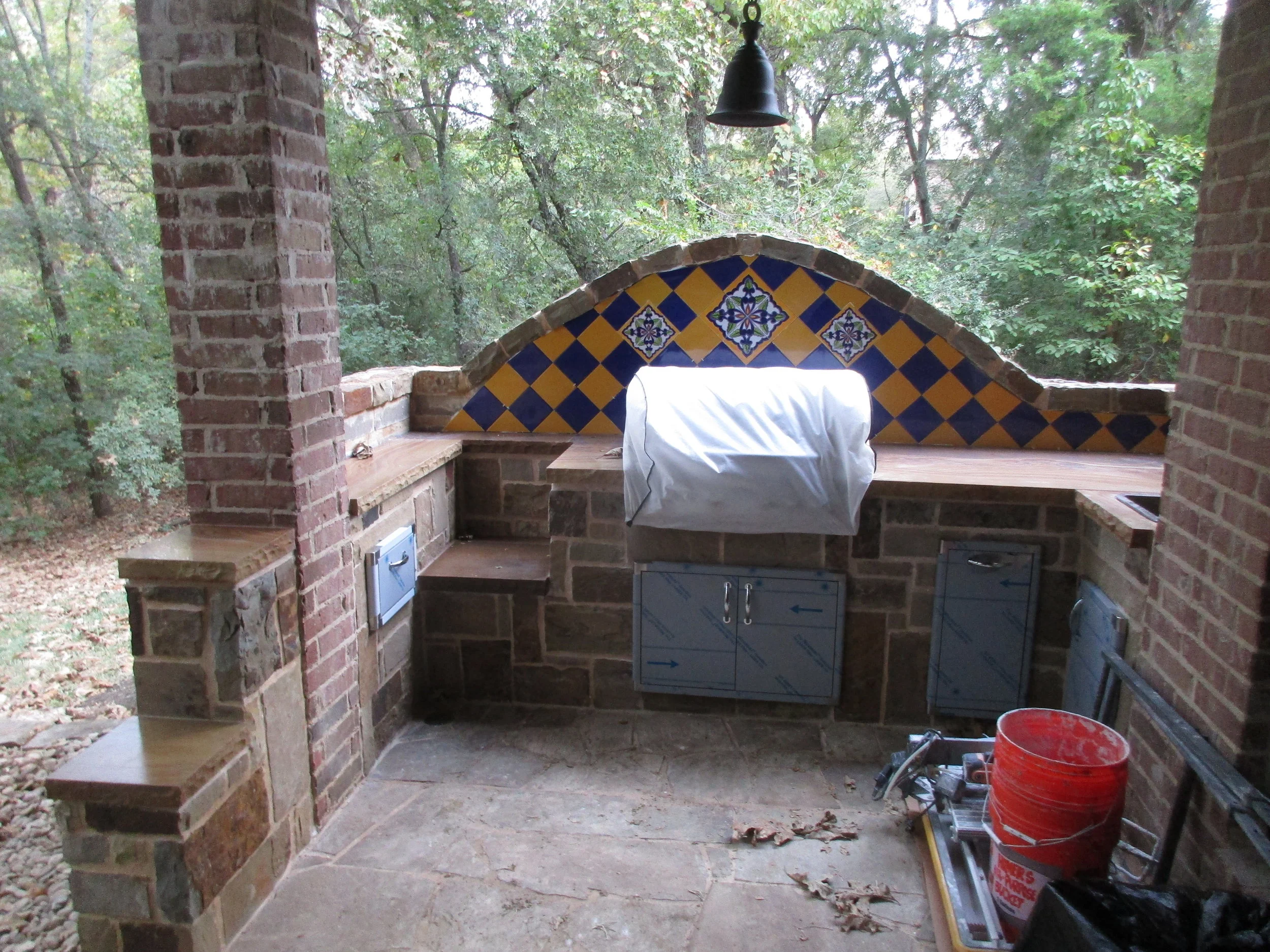
Updated for 2026 | Serving Trophy Club, Southlake, Roanoke, Keller, Haslet & the Greater DFW Metroplex
It's a warm Saturday evening in April, the kind that DFW does better than almost anywhere in the country. Your neighbors are over, the kids are running around the yard, and you're standing behind a beautifully crafted stone outdoor kitchen — grilling, laughing, and genuinely living in the space you always imagined. The smell of mesquite smoke drifts past a custom masonry fireplace. The granite countertops glow in the string lights. It's exactly what you envisioned when you bought your home in Trophy Club or Southlake.
Now here's the harder part: getting there. Because between that vision and that Saturday evening stands one of the most consequential decisions you'll make as a homeowner — choosing the right masonry contractor to build it. This isn't a landscaping refresh or a fresh coat of paint. A masonry outdoor kitchen is a $15,000–$100,000+ investment, permanently attached to your property, that will either enhance your home's value and your quality of life for decades — or become a source of regret, cracked mortar, and costly repairs if the wrong contractor builds it on an inadequate foundation.
That decision paralysis is real. The DFW market is full of contractors claiming expertise, and sorting the genuinely skilled from the merely available is exhausting. This guide does that work for you. We've researched the market, compiled verified contractor information, broken down real pricing data, and outlined exactly what to look for — and what to avoid — so you can move forward with confidence.
Key Takeaways
- DFW's year-round outdoor season and booming suburban growth make masonry outdoor kitchens one of the smartest home investments in the region, with 50–70% ROI at resale.
- Outdoor kitchen masonry costs in DFW range from $6,000 for a basic brick island to $100,000+ for a premium outdoor living suite — understanding what drives cost protects you from sticker shock.
- Texas has no statewide masonry license; verifying General Liability insurance, Worker's Compensation, and city-level registration is your primary protection.
- DFW's expansive clay soils require engineered footings — any contractor who dismisses this is a red flag, not a bargain.
- The five contractors reviewed here are verified, fully insured, and have demonstrated track records in outdoor kitchen masonry across the DFW metroplex.
- Booking in fall or winter can reduce lead times and provide modest negotiating leverage compared to the spring peak season.
- Knowing the right questions to ask before signing a contract is the single most powerful tool you have as a homeowner.
Why DFW Homeowners Are Investing in Masonry Outdoor Kitchens Right Now
If you've been thinking about building an outdoor kitchen, you're not alone — and you're not late. The DFW metroplex is in the middle of a sustained outdoor living boom that shows no signs of slowing. The region is projected to surpass 8.5 million residents in 2026, with the northwest suburban corridor — Roanoke, Haslet, Trophy Club, Keller, and Southlake — leading the growth. New master-planned communities are being built with outdoor living in mind, and existing homeowners in established neighborhoods are investing heavily in backyard transformations to match the lifestyle their community promises.
The climate is the obvious starting point. DFW offers roughly 230+ sunny days per year, with mild springs and falls that stretch the outdoor entertaining season far beyond what most of the country enjoys. An outdoor kitchen here isn't a seasonal novelty — it's a functional extension of your living space for eight or nine months of the year. That's a fundamentally different calculation than building one in Chicago or Seattle.
Then there's the financial reality of the suburbs where these kitchens are being built. Southlake and Westlake median household incomes exceed $250,000. Colleyville sits at $218,328. Flower Mound comes in at $146,896. These are communities where homeowners have both the financial capacity and the genuine desire to invest in premium outdoor spaces — and where neighbors' outdoor kitchens become the benchmark for your own backyard ambitions.
From a pure investment standpoint, the numbers hold up. Homeowners in the DFW market typically recoup 50–70% of their outdoor kitchen investment at resale, according to NAR Remodeling Impact data. Manufactured stone veneer — one of the most popular cladding choices — boasts up to 90% cost recouped. In a market where home values have appreciated significantly and buyers are specifically seeking outdoor living amenities, a well-built masonry outdoor kitchen isn't just a lifestyle upgrade. It's a competitive advantage when you eventually sell.
Understanding how much a masonry outdoor kitchen costs before you start getting quotes is one of the most empowering things you can do as a homeowner — it transforms you from a passive recipient of contractor bids into an informed buyer who knows what fair pricing looks like.
Understanding Outdoor Kitchen Masonry Costs in DFW (2025–2026)
One of the biggest sources of homeowner frustration in this process is receiving wildly different quotes and having no framework to evaluate them. Here's a clear breakdown of what you're actually paying for — and where the numbers come from.
Entry-level outdoor kitchens — think a basic L-shaped brick island with a built-in grill cutout and a simple concrete or tile countertop — typically run $6,000–$12,000 for masonry labor and materials in DFW. These are functional starting points, but they don't include appliances, utility connections, or premium finishes.
Mid-range kitchens — natural stone or manufactured stone veneer cladding, granite countertops, multiple appliance cutouts (grill, side burner, mini-fridge), and a basic sink — land in the $15,000–$35,000 range for masonry and labor. This is where most DFW homeowners in established suburbs end up, and it's where the craftsmanship differences between contractors become most visible.
Premium outdoor living suites — integrated fireplaces, pizza ovens, pergola integration, extensive bar seating, premium appliance packages, and high-end natural stone throughout — start at $40,000 and can easily exceed $100,000 when all components are included. These projects are essentially full backyard transformations and require contractors with genuine design-build expertise.
DFW pricing trends slightly higher than the national average across all tiers. The national mid-range benchmark sits at $12,000–$25,000; DFW's is $15,000–$35,000. That premium reflects the region's high demand, specialized engineering requirements for expansive soils, and the affluent market driving material and labor expectations upward.
⚠️ Don't Forget These Budget Items
The masonry quote is just one line item. Permits ($100–$1,000+), foundation engineering ($500–$2,000+), gas line extensions ($500–$2,000+), outdoor electrical ($500–$2,500+), and plumbing rough-ins ($1,000–$3,000+) are all separate costs that can add $5,000–$10,000+ to your total project budget. Ask every contractor to walk you through the full project cost — not just their portion.
Material selection is the single biggest lever on cost. Natural stone — Austin stone, Lueders limestone, Oklahoma flagstone — is the most expensive per square foot due to both material cost and the specialized labor required to set it properly. Manufactured stone veneer sits in the mid-range, offering a wide variety of aesthetics at lower cost. Brick is cost-effective and often chosen to match existing home architecture. Stucco finishes are the most affordable masonry option but sacrifice some of the premium visual impact.
For a full breakdown of what drives these numbers — and how to read a contractor's quote intelligently — the outdoor kitchen masonry permit requirements in DFW guide covers the regulatory side in detail, including which permits you'll need and what they typically cost in different municipalities.
Why DFW Outdoor Kitchens Cost More: Expansive Clay Soils & Engineering
Here's something that surprises many homeowners new to DFW construction: the ground beneath your backyard is actively working against your outdoor kitchen. DFW's expansive clay soils absorb moisture and swell, then shrink and crack as they dry out. This seasonal movement — sometimes measured in inches — is brutal on heavy masonry structures that aren't properly anchored.
Engineered footings or reinforced concrete slabs aren't optional extras in this market — they're the difference between a masonry outdoor kitchen that lasts 30 years and one that starts cracking within five. Structural engineering for an outdoor kitchen foundation adds $500–$2,000+ to your project, but it's non-negotiable if you want the investment to hold. Any contractor who waves off this requirement or tells you a standard slab will do is either unfamiliar with DFW conditions or cutting corners on your behalf. Neither is acceptable.
Our concrete and retaining wall services page explains how we approach foundation work for heavy masonry structures in DFW's challenging soil environment — it's a useful reference point when evaluating any contractor's foundation approach.
Financing Your Outdoor Kitchen: Options & Rates
For most DFW homeowners, financing a $25,000–$75,000 outdoor kitchen project comes down to a few practical options. Home Equity Loans (HELOANs) and HELOCs are the most popular choice, leveraging your home's appreciated value for competitive rates — typically 6.5%–9.5% APR in the DFW market as of 2025, subject to Texas's 80% LTV cap. These offer predictable payments and relatively low rates compared to other borrowing options.
Some outdoor living contractors partner with specialized lenders who offer direct project financing, similar to pool loan programs. Personal loans are available but carry higher rates (8%–15%+) and shorter terms that increase monthly payments significantly. For very large projects — a full outdoor living suite in the $80,000–$100,000+ range — a cash-out refinance may make sense, though it requires refinancing your entire mortgage and depends heavily on current rate conditions.
Licensing, Insurance & Permits: What You Must Verify Before Hiring
This section might feel like the least exciting part of planning your outdoor kitchen. It isn't. The decisions you make here — or fail to make — are what separate homeowners who have smooth, successful projects from those who end up in disputes, with unpermitted structures, or personally liable for injuries that occurred on their property.
Let's start with the most important thing to understand about Texas: there is no statewide masonry contractor license issued by the Texas Department of Licensing and Regulation (TDLR). This means that technically, anyone can call themselves a masonry contractor in Texas. The absence of a state license requirement makes your own vetting process the primary safeguard — which is exactly why this section matters.
What does exist at the city level: most DFW municipalities — Fort Worth, Dallas, Roanoke, Southlake, Keller — require contractors working within their jurisdiction to register with the city's building department. This typically involves providing proof of insurance and sometimes a bond. It's a baseline check, not a comprehensive credentialing system, but it's worth confirming that any contractor you hire is registered in your specific city.
General Liability insurance with a minimum aggregate limit of $1,000,000 is non-negotiable. This covers property damage or bodily injury caused by the contractor's work. Always request a Certificate of Insurance directly from the contractor — not a screenshot, not a verbal assurance — and if you want to be thorough, call the issuing insurance company to confirm the policy is active.
Worker's Compensation coverage is equally critical. If a contractor's employee is injured on your property and the contractor doesn't carry Worker's Comp, you could be personally liable for their medical bills and lost wages. Ask specifically whether their subcontractors — electricians, plumbers, gas fitters — carry their own coverage or are covered under the general contractor's policy.
On the permits side: a standard outdoor kitchen in DFW will require a building permit for the structure, plus separate permits for gas line extensions, electrical work, and plumbing. If you're adding a pergola or covered structure, a structural permit may also be required. In master-planned communities across Southlake, Trophy Club, and Keller, HOA approval is almost always required before you can even apply for city permits — skipping this step can result in forced demolition of completed work.
For a comprehensive walkthrough of what permits you'll need and how to navigate the approval process in different DFW municipalities, the outdoor kitchen masonry permit guide for DFW is an essential read before you sign anything.
One final non-negotiable: all gas and plumbing work must be performed by TDLR-licensed plumbers, and all electrical work by TDLR-licensed electricians. This isn't a preference — it's a legal requirement in Texas, and it's a safety requirement everywhere. Any contractor who suggests otherwise, or who can't verify the licensing of their utility subcontractors, should be removed from your list immediately.
Navigating permits, insurance verification, and subcontractor coordination can feel like a full-time job on top of your actual job. Brick & Stone Master handles all of it — licensing checks, permit applications, and licensed subcontractor management — so you can focus on what actually matters: designing the outdoor space you've been dreaming about.
Discuss Your Project With Our TeamRed Flags When Evaluating Masonry Contractors for Outdoor Kitchens
The DFW market is competitive, and most contractors you encounter will be legitimate professionals. But the stakes of this investment — and the lack of a state licensing requirement — mean that a small percentage of contractors will either lack the expertise to deliver what they promise or operate in ways that put you at financial and legal risk. Here's what to watch for:
🚨 Warning: These Are Contractor Red Flags
Unwillingness to provide a portfolio of completed outdoor kitchen projects, vague or missing insurance documentation, quotes significantly below competitors, dismissiveness about DFW's expansive clay soil requirements, no written contract or change order process, and inability to name the licensed electricians and plumbers who will handle utility work. Any one of these is a reason to pause. Multiple red flags together are a reason to walk away entirely.
- No portfolio of outdoor kitchen projects: Building a masonry outdoor kitchen is a specialized skill. A contractor who primarily does brick repairs or retaining walls may not have the design-build experience to execute a complex kitchen with proper appliance integration, utility coordination, and finish quality. Ask specifically for outdoor kitchen examples — not just general masonry work.
- Vague or missing insurance documentation: "We're insured" is not the same as a Certificate of Insurance. If a contractor can't produce one within 24 hours, that's a problem.
- Quotes significantly below competitors: The DFW masonry market is competitive, and pricing is relatively transparent. A quote that's 30–40% below the others usually means something is being left out — foundation engineering, permits, licensed utility work, or quality materials. Low bids often become expensive projects when the hidden costs surface mid-construction.
- Dismissiveness about expansive clay soils: This is a DFW-specific knowledge test. Any experienced local contractor knows that engineered footings are standard practice here. A contractor who tells you a basic slab is fine either hasn't built many outdoor kitchens in DFW or is cutting corners you'll pay for later.
- No written timeline or change order process: Verbal commitments about schedule and scope are worth nothing when disputes arise. A professional contractor provides a written project schedule and a clear process for documenting any scope changes with associated cost adjustments before work begins.
- No written warranty on masonry workmanship: Quality contractors stand behind their work. If a contractor won't commit to a written warranty, they're signaling uncertainty about what they're delivering.
For context on what quality masonry work should look like — and what poor workmanship costs to repair — our page on masonry failures and structural issues provides a useful reference for understanding the long-term consequences of cutting corners on foundation and installation quality.
Top 5 Masonry Contractors for Outdoor Kitchens in DFW: Compared and Reviewed
The following five contractors have been selected based on verified local presence, demonstrated outdoor kitchen expertise, strong customer reviews, and confirmed insurance and licensing practices. All five serve the DFW metroplex, with particular strength in the northwest suburban corridor where outdoor kitchen demand is highest.
Each brings different strengths to the table. Your best choice depends on your project scope, location, design preferences, and how much you value specific expertise versus full-service integration. Read each profile carefully before making your shortlist.
ℹ️ How to Use This Comparison
Use this list as your starting shortlist — not as a final decision. Contact at least 2–3 of these contractors for detailed quotes, ask the questions outlined later in this article, and verify their insurance documentation independently. The best contractor for your project is the one who combines the right expertise with the right communication style and a quote that reflects the full scope of your vision.
1. Brick & Stone Master — Bespoke Masonry Artistry & Modern Outdoor Living Design
Address: 3800 Haslet-Roanoke Road Suite 32, Roanoke, Texas 76262
Service Area: Dallas-Fort Worth metroplex, with strong presence in Trophy Club, Roanoke, Southlake, Keller, and Haslet
Brick & Stone Master occupies a distinctive position in the DFW outdoor kitchen market: a team that combines traditional masonry artistry with a genuine understanding of modern outdoor living design. Where many masonry contractors focus on the structural and material execution, Brick & Stone Master approaches each project as a comprehensive backyard transformation — thinking through how the kitchen integrates with the home's architecture, the surrounding landscape, and the homeowner's entertaining style before a single stone is laid.
Customers consistently highlight two things in their reviews: the meticulous quality of the craftsmanship — tight mortar joints, precise appliance integration, clean material transitions — and the transparency of communication throughout the project. In a market where homeowners frequently cite timeline uncertainty and surprise costs as their biggest frustrations, Brick & Stone Master's commitment to clear, consistent communication is a meaningful differentiator.
Their specialties include custom masonry outdoor kitchens, integrated fireplaces and pizza ovens, natural stone and brick work, and full backyard transformations that incorporate premium stonework alongside structural and decorative masonry elements. All subcontractors — electricians, plumbers, gas fitters — are TDLR-licensed, and the company carries comprehensive General Liability coverage.
For homeowners in the northwest DFW corridor, Brick & Stone Master is the recommended choice for projects where craftsmanship, design coherence, and long-term durability are the top priorities. Learn more about their work in the area through the masonry contractors in Roanoke, TX guide.
2. Outdoor Living Patio & Fence — Full-Service Outdoor Living Integration
Address: 3500 W Davis St, Dallas, TX 75211
Service Area: Dallas metro and surrounding suburbs
Outdoor Living Patio & Fence brings a full-service, integrated approach to outdoor living projects that makes them particularly well-suited for homeowners tackling comprehensive backyard transformations — not just a kitchen island, but the entire outdoor living ecosystem including patios, pergolas, fencing, and landscaping coordination.
Their project management capabilities are a standout feature. Customers frequently cite their ability to coordinate multiple trades and project components without the homeowner having to serve as the general contractor. For complex projects with multiple moving parts, this streamlined experience has significant value. Their stone and brickwork quality is consistently praised in reviews, and they appear frequently in both Google searches and Houzz discussions for "outdoor kitchen Dallas."
They are fully insured, with licensed trades managed either in-house or through vetted subcontractors. Best suited for: homeowners in the Dallas metro who want a single point of contact for a comprehensive outdoor living project.
3. Texas Landscape Creations — Landscape Integration & Natural Stone Expertise
Address: 150 E Industrial Blvd, Euless, TX 76040
Service Area: Mid-Cities, Southlake, Keller, Colleyville, and surrounding DFW areas
Texas Landscape Creations distinguishes itself through a particular strength in landscape integration — the ability to design and build outdoor kitchens that feel like they grew organically from the surrounding hardscape and planting design rather than being dropped into an existing yard. For homeowners in Southlake and Keller who have invested in mature landscaping and want their outdoor kitchen to complement rather than compete with it, this expertise is genuinely valuable.
Their material selection capabilities are strong, particularly with natural stone and manufactured stone veneer. Clients commend their creative design approach and attention to detail in choosing materials that work with the home's existing palette. They are fully insured with comprehensive coverage and use licensed subcontractors for all utility work. For homeowners exploring options in the Mid-Cities corridor, the masonry contractors serving Southlake guide provides additional context on this market.
4. DFW Outdoor Living — Luxury Finishes & Detailed Stone Craftsmanship
Address: 2800 Lakeside Dr Ste 100, Flower Mound, TX 75022
Service Area: Flower Mound, Lewisville, Southlake, Trophy Club, and surrounding luxury communities
DFW Outdoor Living has built its reputation around the upper end of the outdoor kitchen market — projects where the homeowner wants extensive stone work, premium built-in appliances, integrated fire features, and the kind of detailed craftsmanship that holds up to close inspection. Their masons' ability to handle intricate stone designs and high-end finishes is consistently praised in customer reviews.
What sets them apart beyond the craftsmanship is their transparent quoting process. Customers specifically mention appreciating the clarity of their bids — knowing what they're paying for and why. In a market where hidden costs and scope creep are common complaints, this transparency is a meaningful differentiator. They are fully insured with all licensed trades verified before project start. Best suited for: luxury communities in the Flower Mound, Southlake, and Trophy Club corridor where premium finishes and detailed stone work are the expectation.
5. Metroplex Masonry — Quality & Efficiency Across Diverse Outdoor Projects
Address: 3110 Justin Rd #236, Flower Mound, TX 75028
Service Area: Northwest DFW, Trophy Club, Roanoke, Flower Mound, and surrounding areas
Metroplex Masonry rounds out this list as a strong option for homeowners who want reliable, quality outdoor kitchen construction without the premium pricing of the luxury-focused contractors. Their reputation is built on efficient project execution and solid, durable construction — clients praise their ability to deliver on schedule with consistent workmanship across both residential and commercial projects.
Their service area overlaps significantly with Brick & Stone Master's northwest DFW territory, and they appear frequently in searches for "masonry Flower Mound" and "outdoor kitchen Trophy Club." They carry standard General Liability and Worker's Compensation coverage. Best suited for: homeowners in northwest DFW seeking a reliable, quality-focused contractor for mid-range outdoor kitchen projects without the premium price point of luxury-specialized firms.
Ready to move forward with Brick & Stone Master? Our team specializes in bespoke outdoor kitchen designs tailored to DFW's climate, your home's character, and your vision for how you want to use the space. Let's talk through your project and put together a detailed quote that covers the full picture — no surprises.
Request a Detailed Quote From Brick & Stone MasterHow to Evaluate Contractor Portfolios & Masonry Workmanship Quality
A contractor's portfolio is their most honest sales pitch. Unlike a verbal promise or a polished website, photographs of completed work reveal the actual quality of craftsmanship — if you know what to look for. Here's how to evaluate what you're seeing.
Mortar joints: This is the first thing an experienced mason notices. Tight, even, consistent mortar joints — uniform in color, depth, and width — indicate skilled, patient workmanship. Uneven joints, visible gaps, crumbling edges, or inconsistent coloring suggest either rushed work or inadequate skill. Zoom in on portfolio photos; this detail is visible even in standard resolution images.
Appliance integration: Look carefully at how grills, side burners, sinks, and refrigerators are set into the masonry. They should fit snugly, with minimal gaps between the appliance frame and the surrounding stone or brick. Visible gaps, uneven cuts, or appliances that appear to be sitting on top of rather than integrated into the masonry are signs of poor planning or execution. This matters practically — gaps allow moisture infiltration and accelerate deterioration.
Corners and edges: Corners are where craftsmanship is tested. Properly finished corners — whether rounded, mitered, or corbeled — require skill and attention. Rough, unfinished, or visibly patched corners indicate a contractor who rushes the details. The same applies to countertop edges: the transition between countertop and masonry cladding should be clean, sealed, and intentional.
Material transitions: Where stone meets brick, or where the kitchen structure meets a pergola column or existing patio, the transition should feel designed — not accidental. Poor transitions often reveal a contractor who executes individual components adequately but doesn't think about the project as a cohesive whole.
Drainage and grading: This is harder to see in photos but worth asking about specifically. Proper grading around the kitchen prevents water pooling, which is one of the most common causes of long-term masonry damage and foundation issues in DFW's clay soil environment. Ask contractors directly: how do you handle drainage in your outdoor kitchen designs?
References: Portfolio photos show you what a contractor can do at their best. References tell you what it's actually like to work with them. Ask for at least three references from outdoor kitchen projects completed in the past two years, and actually call them. Ask about timeline adherence, how change orders were handled, whether the final cost matched the quote, and whether they'd hire the contractor again.
Our masonry design services page showcases examples of the design-build approach we take with outdoor kitchen projects — it's a useful reference for understanding what integrated design planning looks like before construction begins.
What Makes a Durable Outdoor Kitchen in DFW's Demanding Climate
DFW's climate is beautiful for outdoor living and genuinely challenging for outdoor construction. Temperatures regularly exceed 100°F in summer, occasional ice storms hit in winter, UV exposure is intense year-round, and the expansive clay soils beneath your yard are in constant motion. Building an outdoor kitchen that lasts 30 years in this environment requires specific material choices and construction practices — not just good intentions.
💡 Pro Tip: Stone Selection for DFW's Climate
Austin stone, Lueders limestone, and Oklahoma flagstone are proven performers in the DFW climate — they've been used on Texas structures for generations and are well-documented for their resistance to heat, UV, and freeze-thaw cycles. If you're considering manufactured stone veneer, specify products engineered for outdoor use in USDA Hardiness Zone 8 (which covers most of DFW) — not interior or mild-climate products.
Foundation first: We've said it before, but it bears repeating. An engineered footing or reinforced concrete slab is the foundation of a durable outdoor kitchen in DFW. Without it, soil movement will eventually crack your masonry, shift your appliances, and compromise the structural integrity of the entire installation. This is the single most important investment in long-term durability.
Mortar quality: Type N or Type S mortar is appropriate for outdoor masonry in DFW's climate. Type S provides higher compressive strength and better resistance to freeze-thaw cycles — important for the occasional hard freezes DFW experiences. Proper installation technique — consistent joint depth, adequate cure time, protection from extreme temperatures during curing — is as important as the mortar type itself.
Sealing: Natural stone countertops and concrete countertops should be sealed annually or biennially to protect against cooking stains, moisture infiltration, and UV degradation. Masonry cladding may benefit from a penetrating sealer every 3–5 years, particularly in areas exposed to direct cooking heat or moisture. Our masonry cleaning and waterproofing services provide professional-grade protection for completed outdoor kitchen installations.
Outdoor-rated everything: This applies to appliances, electrical fixtures, lighting, and any wood components. Indoor-rated appliances and materials will deteriorate rapidly in DFW's heat and UV exposure. Specify outdoor-rated or commercial-grade components throughout — the cost difference is modest compared to the cost of premature replacement.
Seasonal Timing: When to Book Your Outdoor Kitchen Project in DFW
Timing your outdoor kitchen project strategically can affect your lead time, your negotiating position, and the quality of attention your project receives. Here's how the DFW construction calendar works in practice.
Peak season (March–May and September–November) offers ideal weather conditions for masonry work — mild temperatures, low humidity, and optimal mortar curing conditions. The downside: every other homeowner in DFW knows this too. During peak booking months, lead times for starting a project extend to 4–8 weeks or longer, sometimes 12+ weeks for the most in-demand contractors. You'll have less negotiating leverage on price and scheduling flexibility.
Off-season (December–February) is where strategic homeowners find opportunity. Contractor availability is higher, lead times are shorter, and some contractors will offer more favorable terms to keep their crews working through the slower months. DFW's mild winters allow year-round masonry construction — hard freezes can delay mortar curing, but they're relatively infrequent and predictable. If you're planning a spring reveal, booking in December or January is often the best path to a quality project completed on your timeline.
Summer (June–August) presents a different challenge: extreme heat. Masons working in 100°F+ temperatures must manage mortar carefully — misting, shading, and limiting pour sizes to prevent premature drying and cracking. This often means early morning or late evening work schedules, which can extend project duration. Booking lead times aren't typically worse in summer, but project timelines may be longer than spring or fall equivalents.
On material costs: Natural stone, brick, concrete, and outdoor appliances have seen modest but consistent annual price increases of 2–5% in the North Texas market over the past several years. This trend is expected to continue into 2026. Booking sooner locks in current material pricing; delaying a year means paying more for the same materials. The intangible cost of delay — missing another summer of entertaining in your dream outdoor kitchen — is harder to quantify but very real.
Questions to Ask Before Signing an Outdoor Kitchen Contract
This is your vetting checklist. Use it in every contractor conversation before you commit a dollar. The quality of a contractor's answers to these questions will tell you more than any sales pitch or polished website.
- How many outdoor kitchens have you completed in DFW in the past three years, and can you provide at least three references from those projects? You want specificity here — not "we've done hundreds of masonry projects" but actual outdoor kitchen experience with verifiable references.
- How do you handle DFW's expansive clay soils? What foundation approach do you recommend for my specific site? A knowledgeable contractor will ask about your lot, soil conditions, and kitchen size before answering this. Vague or dismissive answers are a red flag.
- What permits will you obtain, and what is the permit cost breakdown? Who is responsible for permit applications? The answer should be specific to your city and project scope. "We handle all permits" is a good starting answer, but verify the details.
- What is your timeline estimate from contract signing to project completion, and what factors could delay it? Look for realistic, specific answers — not just "a few weeks." A contractor who's done this before knows the variables.
- How do you handle change orders? What is the process if scope changes mid-project? Every change should be documented in writing with a cost adjustment agreed upon before work proceeds. Any other answer is a recipe for disputes.
- What is your payment schedule? Standard practice: 30–50% deposit at contract signing, 30–40% at a defined mid-project milestone, 20% at completion. Be cautious of contractors requesting more than 50% upfront.
- Do you provide a written warranty on masonry workmanship? For how long? Quality contractors stand behind their work with a written warranty. Get the terms in writing before signing.
- Who manages subcontractors — electricians, plumbers, gas fitters — and can you verify their TDLR licensing? You should receive the names and license numbers of any licensed trades working on your project.
- Can you provide a Certificate of Insurance showing General Liability and Worker's Compensation coverage? This is non-negotiable. Request it before any work begins.
- What happens if the project runs over budget or timeline? How are disputes resolved? A professional contractor has a clear answer to this. The contract should specify a dispute resolution process.
For homeowners considering projects that include planter boxes, retaining walls, or additional hardscape elements alongside the outdoor kitchen, our masonry planter box services and retaining wall construction pages provide additional context on how these elements integrate with outdoor kitchen projects.
Have questions about your specific project, site conditions, or how to evaluate the quotes you've received? Brick & Stone Master offers free consultations to walk through your outdoor kitchen vision, answer your questions honestly, and give you a clear picture of what your project will involve — before you commit to anything.
Schedule Your Free ConsultationFeeling Overwhelmed by Choices? You're Not Alone
Choosing the right masonry contractor for a $15,000–$100,000+ outdoor kitchen investment is a major decision. The research, vetting, and comparison process outlined in this guide is intentionally thorough — that's how you protect your investment and ensure a result you'll enjoy for decades. Taking the time to do this properly isn't overthinking it. It's exactly the right level of care for a project of this magnitude.
Frequently Asked Questions About Outdoor Kitchen Masonry in DFW
These are the questions we hear most often from DFW homeowners who are in the planning stages of an outdoor kitchen project. If your question isn't here, the resources linked throughout this article — or a direct conversation with our team — will get you the specific answer you need.
Manufactured stone veneer and natural stone are highly durable in DFW's climate when properly installed with appropriate engineered footings for expansive clay soils and quality Type N or Type S mortar. The key word is "properly" — the same materials installed on an inadequate foundation or with poor mortar technique will fail prematurely regardless of their inherent durability. Regular sealing of countertops and masonry surfaces every 3–5 years protects against weathering, UV degradation, and cooking stains, ensuring 20–30+ years of reliable performance when combined with quality installation from the start.
For a comprehensive outdoor kitchen that includes appliances, utility connections (gas, water, electrical), and integrated features like fireplaces or pergolas, a dedicated outdoor kitchen builder or a masonry contractor who specializes in outdoor living is the stronger choice — they manage all trades and think about the project holistically. A general masonry contractor excels at the stone and brick work itself but typically requires you to coordinate electricians, plumbers, and gas fitters separately, which adds complexity and responsibility to your plate. The more integrated and complex your vision, the more valuable a contractor with full-project experience becomes.
You'll need a building permit for the structure itself, plus separate permits for any gas line extensions, electrical work (outlets, refrigeration circuits, lighting), and plumbing (sink supply and drain). If you're adding a pergola, shade structure, or any roofed element, a structural permit is typically required as well. In master-planned communities like Southlake's Timarron or Trophy Club's various HOA-governed neighborhoods, you'll also need HOA approval before city permits can be applied for — this is a step that surprises many homeowners and can add several weeks to the pre-construction timeline. Always verify requirements with your specific city's building department and your HOA before finalizing your design.
Timeline varies significantly by project scope: a basic grill island with brick cladding and a simple countertop typically takes 2–4 weeks of active construction; a mid-range fully equipped kitchen with utilities, multiple appliances, and natural stone cladding takes 4–8 weeks; a premium outdoor living suite with an integrated fireplace, pizza oven, pergola, and extensive stonework can take 8–16 weeks or more. These timelines cover active construction only — they don't include permit approval times (which can add 2–6 weeks depending on your municipality and project complexity) or potential weather delays during winter months. Plan your project timeline from the date you sign a contract, not the date you want to start entertaining.
Outdoor kitchens provide measurable, documented value in the DFW market — homeowners typically recoup 50–70% of their investment at resale, according to NAR Remodeling Impact data. Manufactured stone veneer, one of the most popular outdoor kitchen cladding materials, boasts up to 90% cost recouped in the same data set. Given DFW's long outdoor season, strong cultural emphasis on outdoor entertaining, and the high demand for outdoor living amenities in affluent suburbs like Southlake, Trophy Club, and Flower Mound, a well-built outdoor kitchen significantly boosts both curb appeal and buyer interest. It's both a personal luxury and a genuine investment — the best kind of home improvement.
The most common and costly mistakes include underestimating the total budget by focusing only on the masonry quote and overlooking permits, utility rough-ins, and appliances; neglecting proper foundation planning for DFW's expansive clay soils; failing to obtain required permits (which can result in forced demolition of completed work); choosing appliances not rated for outdoor use in extreme heat and UV conditions; and insufficient counter space or storage for how you actually plan to use the kitchen. On the contractor side: not getting multiple detailed quotes, skipping thorough vetting of insurance and licensing, and failing to get a written change order process in place before construction begins are the errors that most often lead to disputes and cost overruns.
Ready to Transform Your Backyard Into Your Dream Outdoor Kitchen?
We know this decision carries real weight. A masonry outdoor kitchen is one of the most significant investments you'll make in your home, and you deserve a contractor who brings both the craftsmanship and the transparency to deliver exactly what you envisioned — on time, on budget, and built to last in DFW's demanding environment.
Brick & Stone Master combines traditional masonry artistry with modern outdoor living design to create outdoor kitchens that are as beautiful as they are durable. Whether you're in Trophy Club, Southlake, Roanoke, Haslet, or anywhere across DFW, we're ready to discuss your vision, answer every question you have, and deliver a project that exceeds expectations.
Contact us today for a free consultation and detailed quote. No pressure, no sales pitch — just an honest conversation about what's possible for your backyard.
Get Your Free Outdoor Kitchen ConsultationBrick & Stone Master | 3800 Haslet-Roanoke Road Suite 32, Roanoke, Texas 76262 | Serving the DFW Metroplex