
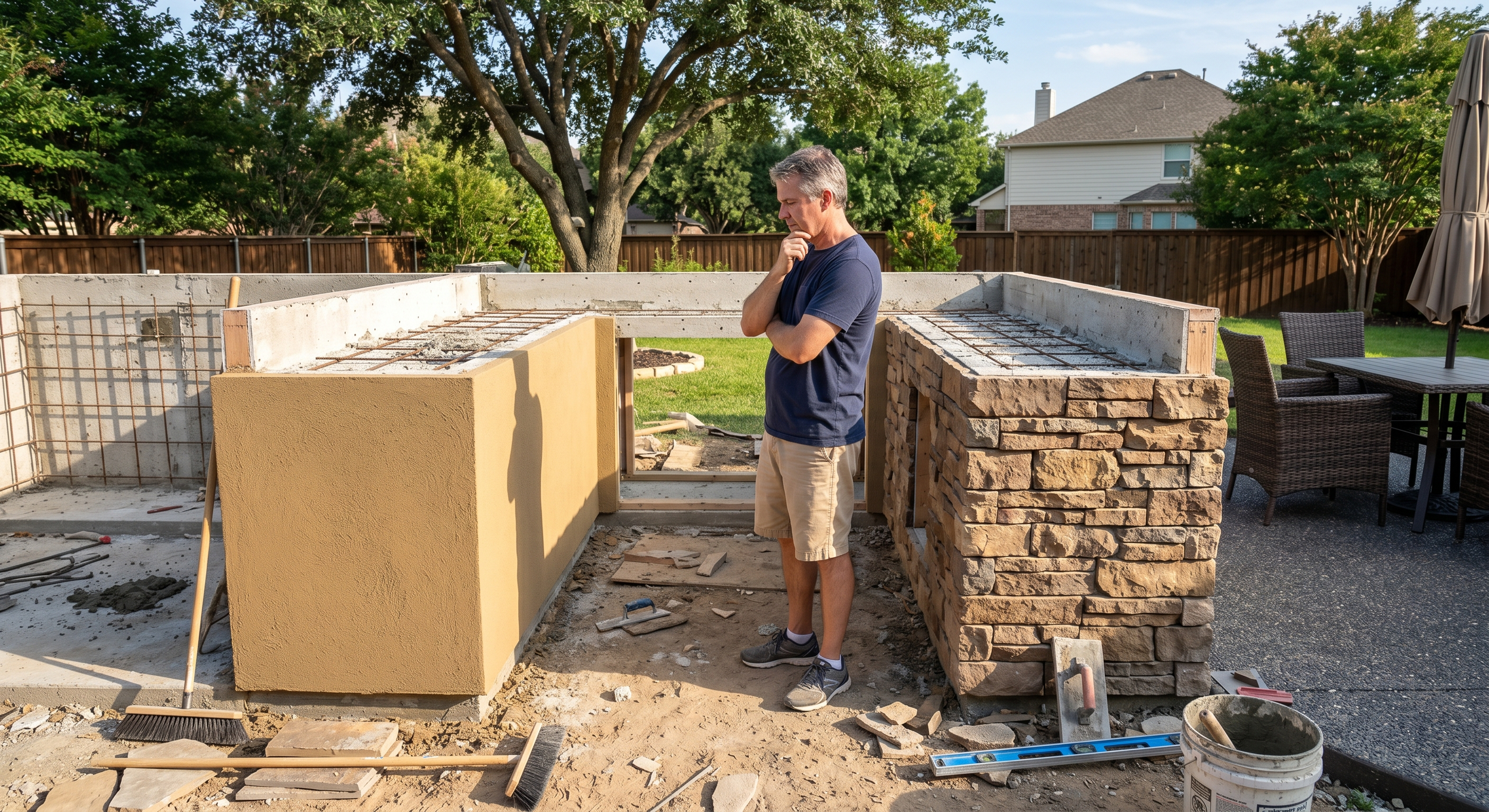
You spent $10,000 on a beautiful BBQ island. Eighteen months later, you're standing in your backyard staring at a spiderweb of hairline cracks running across the stucco finish — or worse, chalky white mineral deposits blooming across the cultured stone. You thought you'd made a solid, low-maintenance choice. Now you're wondering what went wrong and how much it's going to cost to fix it.
This scenario plays out more often than most contractors will admit. Dallas-Fort Worth homeowners invest anywhere from $8,000 to $18,000 in masonry BBQ islands every year, and a significant number of them are surprised — sometimes unpleasantly — by how much attention their "low-maintenance" finish actually demands. The problem usually isn't the material itself. It's that nobody sat down and explained what each finish actually requires to stay looking good for 20-plus years in a Texas climate.
This guide does exactly that. We're going to compare stucco and cultured stone BBQ island finishes honestly — maintenance demands, repair costs, climate performance, and long-term ownership realities — so you can make a decision you'll still feel good about a decade from now.
Key Takeaways
- Neither stucco nor cultured stone is truly maintenance-free — both require annual inspection, periodic sealing, and occasional repairs.
- Cultured stone edges out stucco for predictable, scheduled maintenance and nearly invisible repairs when damage occurs.
- Stucco offers a lower upfront cost but demands more frequent preventive attention, especially in DFW's extreme temperature swings.
- Installation quality matters more than material choice — a well-installed stucco finish will outlast poorly installed cultured stone by years.
- Stucco maintenance runs approximately $200–$500 per year; cultured stone runs $300–$600 per year, but costs are more predictable.
- Over a 20-year ownership window, total maintenance costs for both materials are roughly comparable — but the type of work is different.
- DFW's specific climate (extreme heat, UV exposure, occasional freeze-thaw cycles) slightly favors cultured stone's rigid structure for long-term performance.
Why BBQ Island Finish Material Matters More Than You Think
When most homeowners choose a BBQ island finish, they're thinking about aesthetics — does it look rustic? Modern? Does it match the house? Those are legitimate questions. But the finish material you choose is also a 20-year maintenance commitment, and that part of the conversation rarely happens at the design stage.
Your finish material determines how often you'll need to inspect, clean, seal, and repair your BBQ island. It determines what happens when a heavy pot chips the surface, when Texas summer UV hammers the color for a decade straight, or when a rare DFW freeze-thaw cycle stresses the mortar joints. These aren't hypothetical concerns — they're the realities of outdoor masonry in North Texas.
The outdoor living market is booming. According to Future Market Insights, the global outdoor living structure market was valued at $3.30 billion in 2025 and is projected to reach $6.60 billion by 2036, growing at a CAGR of 6.5%. The residential segment alone is expected to account for 61% of that market revenue. Homeowners are investing heavily in outdoor spaces — but not all of them are thinking carefully about what it takes to protect those investments over time.
Understanding how much a masonry outdoor kitchen truly costs means looking beyond the initial installation price. A poor finish choice can turn a relaxing outdoor space into a maintenance headache within two to three years. Homeowners who factor in sealing schedules, repair frequency, and long-term refinishing costs before they build are the ones who end up genuinely satisfied with their outdoor kitchens a decade later.
You're Right to Question 'Low-Maintenance' Claims
Neither stucco nor cultured stone is truly maintenance-free. Both require annual inspection, periodic sealing, and occasional repairs. The real question is which type of maintenance fits your lifestyle and budget — not which material requires zero effort. Any contractor who tells you otherwise isn't being straight with you.
Understanding Stucco Finish: Composition, Application, and Performance
Stucco is one of the oldest exterior finish materials in the world, and it earned that longevity for good reasons. At its core, stucco is a multi-layer cement-based coating applied over a masonry, brick, or stone substrate. A properly executed stucco job involves three coats: the scratch coat (which bonds to the substrate), the brown coat (which builds thickness and provides a flat base), and the finish coat (which delivers the final texture and color). Each layer serves a structural purpose, and skipping or rushing any of them is where problems start.
The composition is straightforward: Portland cement, sand, lime, and water. The finish coat often includes pigments for color and texture additives to achieve anything from a smooth California finish to a rough Spanish lace. That flexibility is one of stucco's biggest advantages — it's highly customizable and can be matched to virtually any architectural style.
Stucco has a natural affinity for warm climates. Its breathability allows moisture vapor to escape rather than becoming trapped behind the surface, which reduces the risk of mold, mildew, and substrate damage in humid conditions. For Texas, that's a meaningful advantage during spring and fall when humidity levels spike. However, stucco's performance is only as good as its installation. Inadequate substrate preparation, incorrect cement-to-sand ratios, or insufficient curing time are the most common causes of premature stucco failure — and these are installation problems, not material problems. Working with professional masonry contractors experienced in outdoor kitchens is the single most important factor in getting a stucco finish that actually holds up.
Stucco Durability in Texas Heat and Humidity
Texas heat is not gentle on any exterior material, and stucco is no exception. The good news is that stucco's breathability genuinely helps it manage moisture — it doesn't trap water behind the surface the way some less porous coatings do. In DFW's humid spring and fall seasons, that matters.
The challenge comes from thermal stress. DFW regularly sees 100°F+ days in summer and temperatures that can drop to freezing in winter. That 60-70 degree swing causes stucco to expand and contract, and over years, that movement creates hairline cracks. This is normal behavior for the material — it doesn't mean your stucco was installed incorrectly — but it does mean you need to inspect and address those cracks before they allow water infiltration.
UV exposure is another real concern. Pigmented stucco finishes can fade noticeably over five to ten years without protective coatings, particularly in darker or more saturated colors. Properly sealed stucco can last 20 or more years in good condition; unsealed or poorly maintained stucco may show significant wear in 10 to 15 years. The difference between those two outcomes is almost entirely about the maintenance schedule you keep.
Cultured Stone Veneer: What It Is and How It Performs Outdoors
Cultured stone — also called manufactured stone veneer — is not natural stone quarried from the earth. It's a manufactured product made from Portland cement, aggregates, and iron oxide pigments cast in molds designed to replicate the look of natural fieldstone, ledgestone, river rock, and dozens of other profiles. The result is a lightweight veneer that achieves the visual character of natural stone at a fraction of the weight and cost.
On a BBQ island, cultured stone is adhered to the substrate — typically a foam core or masonry block — using mortar, creating a thin veneer layer rather than a solid stone wall. This is an important distinction: you're looking at a surface treatment, not structural stone. The thin veneer application process requires skill and attention to substrate preparation, waterproofing membranes, and mortar selection. Done right, it produces a stunning, durable finish. Done carelessly, it fails within a few years.
One thing homeowners often don't realize about cultured stone: individual pieces can vary slightly in color and texture, even within the same batch. Over time, weathering and UV exposure can create visible inconsistencies as some pieces fade faster than others. This isn't a defect — it's the nature of a pigmented cement product — but it's worth knowing before you commit to a specific style or color palette.
Cultured stone is heavier than stucco and requires proper substrate support to prevent sagging or separation over time. This is another reason why contractor experience matters — an experienced mason knows how to engineer the substrate correctly for the specific veneer being used.
Cultured Stone Durability in Outdoor Environments
Cultured stone's rigid composition gives it a meaningful advantage in resisting thermal stress. Where stucco flexes slightly with temperature changes — which is what causes those hairline cracks — cultured stone pieces are more dimensionally stable. That doesn't mean they're immune to damage, but the cracking pattern is different and often less pervasive.
The real vulnerability in cultured stone isn't the stone itself — it's the mortar joints. Mortar is softer than stone and weathers faster. In DFW's climate, mortar joints can crack, erode, or allow water infiltration if they're not properly sealed and maintained. Efflorescence — those chalky white mineral deposits that appear on masonry surfaces — is a common complaint on cultured stone in humid climates, and it's almost always a sign of moisture moving through compromised mortar joints.
Sealing is non-negotiable for outdoor cultured stone in Texas. Resealing every two to three years is the standard recommendation, and it's not optional if you want the finish to look good at year 15. With proper maintenance — sealing, joint inspection, and periodic cleaning — cultured stone can last 20 to 30 or more years on a BBQ island. Without it, you'll see accelerated deterioration, particularly in the mortar joints.
Not sure which material is right for your specific situation? A licensed masonry contractor can assess your climate, budget, and maintenance preferences to recommend the best finish for your BBQ island.
Find Experienced Outdoor Kitchen Contractors in DFWStucco Maintenance: What to Expect Year-Round
Let's get specific about what stucco maintenance actually looks like on a DFW BBQ island — not the optimistic version from a brochure, but the realistic picture of what you'll be doing and spending year after year.
Annual inspection is your first line of defense. The best time to do this in DFW is late winter or early spring, after any freeze-thaw stress has occurred but before summer heat sets in. You're looking for hairline cracks, soft spots, color changes, and any areas where the stucco sounds hollow when tapped. Catching small problems at this stage costs you almost nothing. Ignoring them for two or three years can turn a $50 repair into a $1,500 section replacement.
Cleaning should happen one to two times per year. A mild detergent solution and a soft brush handle most dirt, algae, and light mildew. Pressure washing is possible but needs to be done carefully — too much pressure can erode the finish coat, open up hairline cracks, or drive water into the substrate. If you're not confident with pressure washing technique, a hand wash is safer and almost as effective.
Sealing is the most important preventive maintenance task for stucco, and it's the one most homeowners skip. A quality masonry sealer should be applied every three to five years to maintain water resistance and protect against UV fading. This is especially important in DFW, where summer UV is intense and winter moisture can exploit any unsealed cracks. For information on brick repair and masonry maintenance costs in North Texas, it's worth understanding how quickly deferred maintenance can compound.
Repainting or refinishing is typically needed every seven to ten years, depending on your color choice and how consistently you've sealed the surface. Darker colors fade faster. Textured finishes hide wear better than smooth ones. Budget roughly $200 to $500 per year for materials and minor repairs, and plan for a more significant refinishing investment in the $800 to $2,000 range every decade or so.
Total annual maintenance time for stucco: four to eight hours, spread across inspection, cleaning, and minor repairs. That's manageable — but only if you actually do it on schedule.
Common Stucco Problems and How to Spot Them Early
Knowing what to look for makes your annual inspection much more productive. Here are the five most common stucco problems on BBQ islands and what they indicate:
- Hairline cracks: Usually cosmetic, but they become water infiltration pathways if left unsealed. Treat them with flexible masonry caulk or stucco patch and seal the area.
- Stair-step cracks: These follow mortar joints in the underlying masonry and typically indicate structural movement or settling. They require professional evaluation before repair.
- Soft spots or spalling: If the stucco feels spongy or chunks are falling away, you likely have substrate failure or water damage behind the finish. This needs immediate professional attention — it won't get better on its own.
- Color fading or chalking: Normal with age and UV exposure. It indicates the surface needs resealing or repainting, not structural repair.
- Mold or mildew: Common in shaded areas or near the grill where grease vapor accumulates. Treatable with appropriate cleaning solutions, but recurring mold suggests a drainage or ventilation problem that needs to be addressed at the source.
Cultured Stone Maintenance: Sealing, Cleaning, and Joint Care
Cultured stone maintenance has a reputation for being easier than stucco, and in some ways that reputation is earned. But "easier" doesn't mean "less important." The consequences of neglecting cultured stone maintenance can be just as costly as ignoring stucco problems — they just show up differently.
Sealing is the cornerstone of cultured stone maintenance. The veneer surface and mortar joints should be sealed every two to three years with a penetrating masonry sealer designed for manufactured stone. This protects against moisture infiltration, staining from grease and cooking residue, and the efflorescence that's so common on outdoor stone in Texas. Skipping sealing doesn't cause immediate visible damage — it causes slow, invisible deterioration that becomes expensive to fix years later. For professional cleaning and waterproofing of masonry surfaces, working with specialists who understand manufactured stone products makes a real difference in results.
Cleaning should happen one to two times per year. Unlike stucco, cultured stone is more sensitive to aggressive cleaning methods. Use a mild detergent and a soft-bristle brush. Avoid muriatic acid cleaners unless specifically recommended for your product — they can etch the surface and damage the pigments. For efflorescence, use a cleaner specifically formulated for masonry; white vinegar diluted in water is a gentler option for light deposits.
Annual mortar joint inspection is essential. You're looking for cracks, erosion, gaps where the mortar has pulled away from the stone, or any areas where the joint feels soft or crumbly. Minor issues can be addressed with mortar caulk; significant erosion requires repointing — the process of removing failed mortar and replacing it with fresh material. Repointing may be needed every 10 to 15 years depending on climate exposure and original installation quality.
One genuine advantage cultured stone has over stucco: individual pieces can be replaced if damaged. If a stone gets chipped by a falling grill grate or cracked by an impact, a skilled mason can remove that piece and install a replacement without disturbing the surrounding surface. That kind of targeted repair is simply not possible with stucco, where any patch is visible against the surrounding finish.
Total annual maintenance time for cultured stone: three to six hours. Annual cost: $300 to $600, including periodic sealing and occasional joint touch-ups.
Why Mortar Joints Are the Real Maintenance Challenge
Why Mortar Joints Are the Real Maintenance Challenge
In cultured stone, mortar is softer than stone and weathers faster. It's the primary pathway for water infiltration if compromised. Freeze-thaw cycles in DFW winters cause mortar to expand and contract, leading to cracks over time. Proper mortar selection and repointing every 10 to 15 years extends cultured stone life significantly — and this is where cutting corners during installation creates the most expensive long-term problems.
Mortar is a fundamentally different material than the stone it holds together. It's designed to be slightly softer — that's intentional, because it allows the mortar to absorb stress rather than transferring it to the stone. But that softness also means it weathers faster. In a DFW climate with 100-degree summers and occasional freezing winters, mortar joints are under constant thermal stress.
When mortar joints fail, water gets in. Water behind cultured stone causes the veneer to separate from the substrate, promotes mold growth, and can damage the underlying structure of the BBQ island. The damage is often invisible until it's significant — which is why annual joint inspection matters so much. Repointing failed mortar is labor-intensive work that can cost $500 to $1,500 or more depending on the extent of the damage. Proper mortar selection and installation quality upfront can extend the life of the joints by a decade or more.
Head-to-Head Comparison: Maintenance Burden and Long-Term Costs
Now that you understand each material individually, let's put them side by side where it actually matters: maintenance burden, cost over time, and the quality of your experience as an owner.
Initial cost: Stucco finishes typically run $8,000 to $12,000 for a mid-range BBQ island in the DFW market. Cultured stone finishes range from $12,000 to $18,000 due to higher material and labor costs. That $4,000 to $6,000 difference is real money — but it needs to be evaluated against 20 years of ownership costs, not just the installation invoice.
Annual maintenance cost: Stucco runs approximately $200 to $500 per year in materials and minor repairs. Cultured stone runs $300 to $600 per year, with the higher end reflecting the more frequent sealing schedule (every two to three years vs. three to five years for stucco). Over 20 years, the difference in total maintenance cost is relatively small — but the pattern is different. Stucco costs are less predictable, with occasional larger expenses when cracks require professional repair or sections need refinishing. Cultured stone costs are more scheduled and consistent.
Maintenance effort: Stucco requires more frequent preventive attention. You need to catch hairline cracks before they become water infiltration problems, which means diligent annual inspection. Cultured stone maintenance is more scheduled — seal every two to three years, inspect joints annually, clean twice a year. If you're the type of homeowner who keeps a maintenance calendar and sticks to it, cultured stone's predictable schedule may feel easier to manage. If you prefer to deal with things as they come up, stucco's lower sealing frequency might suit you better — just be prepared for the inspection discipline it requires.
Repair visibility: This is where cultured stone has a clear advantage. Stucco patches are often visible even when done professionally, particularly on textured or colored finishes. Matching the exact texture and color of aged stucco is genuinely difficult. Cultured stone repairs — individual piece replacement — are nearly invisible when done by a skilled contractor. If the appearance of your BBQ island matters to you (and it should, given what you paid for it), this is a significant factor.
For a detailed look at when it makes sense to handle maintenance yourself versus calling a professional, the guide on DIY vs. professional masonry for outdoor kitchens breaks down the cost and quality tradeoffs clearly.
Repair Difficulty and Cost: Which Material Is Easier to Fix?
Watch Out for Hidden Repair Costs
Stucco patches are often visible even when professionally done, sometimes requiring full section refinishing that can cost $1,500 or more. Cultured stone repairs are nearly invisible but require matching pieces that may be discontinued years after your original installation. Budget for repairs as part of ownership — not as unexpected emergencies — and ask your contractor about material availability before you commit to a specific product.
When damage happens — and over 20 years, it will — the ease and cost of repair becomes one of the most important factors in your long-term satisfaction with your BBQ island finish. This is an area where the two materials diverge significantly.
Stucco crack repair: Small hairline cracks can be addressed with DIY stucco patch kits for $50 to $200 in materials. Professional repair of small cracks typically runs $200 to $500. The challenge isn't the repair itself — it's making the repair invisible. Stucco has texture, color, and a patina that develops over time. A fresh patch almost always looks different from the surrounding aged surface, even when a skilled contractor does the work. In some cases, the only way to achieve a consistent appearance is to refinish an entire section or the whole surface, which can cost $1,500 or more.
Large stucco repairs: Spalling, substrate failure, or significant cracking can require section removal and replacement. These repairs range from $500 to $1,500 or more depending on the extent of damage and whether the underlying substrate needs work. At this level, the repair is almost always visible.
Cultured stone piece replacement: Individual damaged stones can be removed and replaced by a skilled mason. The repair is nearly invisible when done well, and it doesn't affect the surrounding surface. Cost typically runs $300 to $800 per piece, including labor. The main risk is material availability — if your specific cultured stone profile has been discontinued, finding an exact match becomes difficult. This is a real consideration for long-term ownership, and it's worth asking your contractor about product availability and whether they can source additional pieces for future repairs before installation.
Cultured stone mortar repointing: Labor-intensive but straightforward for an experienced mason. Cost depends on the extent of failed mortar — minor touch-ups might run $500, while significant repointing of a large BBQ island can cost $1,500 to $2,000 or more. For a detailed breakdown of what brick and stone repair costs in Fort Worth look like across different scenarios, it helps to have realistic numbers before you're in the middle of a repair situation.
Understanding repair costs is crucial to your decision. If you'd like a detailed breakdown of what repairs might cost for your specific project, our team can provide a free assessment with no obligation.
Schedule a Free ConsultationClimate Considerations: How DFW Weather Affects Each Material
DFW Climate Favors Cultured Stone Slightly
Dallas-Fort Worth's extreme temperature swings and occasional freeze-thaw cycles stress stucco's more flexible composition more than cultured stone's rigid structure. If you're in DFW specifically, cultured stone's predictable, joint-focused maintenance may be easier to manage long-term — particularly if you're building an island in a location with significant sun exposure and seasonal temperature variation.
DFW's climate is genuinely challenging for exterior masonry. You're dealing with 100°F+ summer days, intense UV radiation, humidity that spikes in spring and fall, occasional heavy rain events, and winters that occasionally dip below freezing. No exterior finish material handles all of that effortlessly — but stucco and cultured stone respond to those stresses differently.
Summer heat and UV: Both materials are affected by UV exposure over time. Stucco pigments tend to fade faster than cultured stone pigments, particularly in darker colors, without protective sealers. Cultured stone fades more subtly and more uniformly, which tends to look more like natural aging and less like neglect. In both cases, quality sealers with UV inhibitors significantly slow the fading process.
Humidity and moisture: Stucco's breathability is a genuine advantage here. It allows moisture vapor to move through the material rather than becoming trapped, which reduces the risk of mold, mildew, and substrate damage. Cultured stone is less breathable, which means moisture management — proper drainage, sealed joints, and waterproofing membranes — is even more critical during installation.
Freeze-thaw cycles: DFW doesn't experience the severe freeze-thaw cycles of northern climates, but they do happen. When they do, water that has infiltrated cracks or mortar joints expands as it freezes, widening those openings. Cultured stone's rigid composition resists this stress better than stucco's more flexible composition. For stucco, this is another reason why sealing cracks promptly after winter is so important.
Stucco is traditionally associated with warm, dry climates — think California and the Southwest. DFW's combination of heat and humidity is manageable for stucco, but it's not the ideal environment. Cultured stone is more universally adaptable across climate types, which gives it a slight edge in DFW's variable conditions. For climate-specific installation guidance, working with masonry contractors experienced in the Dallas-Fort Worth area ensures your installation accounts for local weather realities.
Installation Quality: Why It Matters More Than Material Choice
Pro Tip: Installation Quality Trumps Material Choice
A well-installed stucco finish will outperform poorly installed cultured stone by years — and vice versa. Before you spend time debating materials, invest time in finding a contractor with proven outdoor kitchen experience. The contractor you choose has more impact on your long-term satisfaction than the finish material you select. Ask for project photos, references, and specific experience with BBQ island construction.
Here's the truth that most material comparison guides don't tell you: the single biggest predictor of how your BBQ island finish performs over 20 years is not whether you chose stucco or cultured stone. It's whether the person who installed it knew what they were doing.
Stucco failure is almost always an installation problem, not a material problem. The most common culprits are inadequate substrate preparation, incorrect cement-to-sand ratios in the mix, insufficient curing time between coats, and missing or improperly placed control joints. Control joints are particularly important — they're the planned weak points that allow the stucco to flex without cracking randomly. A contractor who skips control joints to save time is setting you up for a cracked finish within three to five years.
Cultured stone failure follows a similar pattern. Improper mortar application — too thick, too thin, wrong mix, or applied to a dirty substrate — leads to veneer separation. Missing waterproofing membranes behind the stone allow moisture to accumulate against the substrate. Inadequate substrate support causes sagging or cracking over time. These are all installation errors that show up years after the contractor has been paid and moved on.
Waterproofing and drainage design deserve special emphasis. Both stucco and cultured stone need proper moisture management systems — not just surface sealers, but drainage planes that direct water away from the substrate. This is an area where general masonry contractors sometimes lack the specific knowledge that outdoor kitchen specialists have. A BBQ island has unique moisture challenges: it's exposed on all sides, it's near water sources, and cooking creates steam and grease vapor that can work into surface materials over time.
Building permits and inspections provide an important quality checkpoint. They're not just bureaucratic requirements — they ensure that your installation meets code standards for structural integrity, fire clearances, and gas line safety. Contractors who push back on permits or suggest skipping them are a red flag. Understanding outdoor kitchen masonry permits and building codes in DFW before you start the project protects your investment and your safety.
Finally, contractor warranties matter. A reputable masonry contractor stands behind their work with a written warranty. If problems develop within the warranty period — cracks, veneer separation, mortar failure — you have recourse. Contractors who don't offer warranties are telling you something important about how confident they are in their own work. You can explore the full range of professional stonework services available for outdoor applications to understand what quality installation looks like.
Installation quality is the real differentiator between materials that last 15 years and those that last 25+. Working with experienced outdoor kitchen contractors ensures your investment is protected from day one.
Find Experienced Outdoor Kitchen Contractors in DFWThe Verdict: Which Finish Requires the Least Maintenance?
After walking through the composition, durability, maintenance demands, repair costs, and climate performance of both materials, here's the honest answer: cultured stone edges out stucco for lowest maintenance in the DFW market — but the margin is narrower than most people expect, and it comes with important caveats.
Cultured stone wins if you prioritize: predictable, scheduled maintenance over reactive repairs; nearly invisible damage repair; and a rigid structure that handles DFW's temperature swings with slightly less stress. The mortar joint focus of cultured stone maintenance is more manageable than stucco's broader surface maintenance demands, and the ability to replace individual pieces without affecting the whole surface is a significant long-term advantage.
Stucco wins if you prioritize: lower upfront cost; design flexibility (stucco can be tinted and textured in virtually unlimited ways); and a material that's been proven in Texas climates for generations. If you're willing to commit to a consistent inspection and sealing schedule, stucco can deliver 20-plus years of good performance at a lower initial investment.
Neither material is the right choice for every homeowner. Your decision should factor in your budget, your tolerance for different types of maintenance work, and your priorities around repair visibility. If the thought of visible patches on your BBQ island bothers you, cultured stone is the better choice. If you're comfortable with more frequent preventive maintenance in exchange for a lower initial cost, stucco is a legitimate option.
For additional context on how masonry materials compare across different outdoor applications, the guide on natural stone vs. poured concrete for outdoor bars and kitchens provides useful perspective on the broader material landscape. And if you're still weighing your options, the masonry repair services page gives you a sense of what professional maintenance and repair looks like in practice.
"The best BBQ island finish is the one that matches your maintenance habits — not the one that looks best in a showroom. Be honest with yourself about how much time and attention you'll realistically give your outdoor kitchen, and choose accordingly."
Frequently Asked Questions About Stucco and Cultured Stone BBQ Islands
How much does a stucco vs. cultured stone BBQ island typically cost in Dallas-Fort Worth?
Stucco finishes typically cost $8,000 to $12,000 for a mid-range BBQ island in the DFW market, while cultured stone finishes range from $12,000 to $18,000 due to higher material and labor costs. Exact pricing depends on the size of the island, design complexity, substrate requirements, and the contractor you hire. Both materials are available across budget tiers, but cultured stone generally commands a premium for its durability, repairability, and aesthetic appeal. It's worth getting multiple quotes from licensed masonry contractors to understand what your specific project will cost.
Which finish is more durable in Texas heat and humidity?
Both materials are durable in the Texas climate, but they excel in different conditions. Stucco's breathability helps it shed moisture in humid conditions, reducing the risk of mold and substrate damage — an advantage during DFW's humid spring and fall seasons. Cultured stone's rigid composition resists thermal stress from extreme temperature swings better than stucco's more flexible structure, which is an advantage in DFW's hot summers and occasional freezing winters. With proper installation and a consistent maintenance schedule, both materials can last 20-plus years in DFW. The bigger durability factor is installation quality, not material choice.
How much maintenance does each material require annually?
Stucco requires approximately four to eight hours of annual maintenance — inspection for cracks, cleaning one to two times per year, and sealing every three to five years — at an estimated cost of $200 to $500 per year in materials and minor repairs. Cultured stone requires three to six hours annually — sealing every two to three years, mortar joint inspection, and cleaning — at an estimated cost of $300 to $600 per year. Cultured stone maintenance is more predictable and scheduled; stucco maintenance requires more frequent preventive attention to catch hairline cracks before they become water infiltration problems. Both require genuine commitment to stay in good condition long-term.
Is cultured stone or stucco easier to repair if it gets damaged?
Cultured stone is significantly easier to repair invisibly. Individual damaged pieces can be removed and replaced by a skilled mason for $300 to $800 per piece, and the repair is nearly undetectable when done well. Stucco patches, by contrast, are often visible even when professionally executed — matching the texture, color, and patina of aged stucco is genuinely difficult, and significant damage sometimes requires refinishing an entire section at a cost of $1,500 or more. For homeowners who care about the long-term appearance of their BBQ island, cultured stone's repairability is one of its most compelling advantages over stucco.
How long does each finish typically last on a BBQ island?
Properly installed and maintained stucco lasts 20-plus years; unsealed or poorly maintained stucco may show significant wear in 10 to 15 years. Cultured stone lasts 20 to 30-plus years with proper sealing and mortar joint care. In both cases, lifespan depends heavily on installation quality, climate exposure, and how consistently the maintenance schedule is followed — not just on the material itself. A well-installed stucco finish will outlast poorly installed cultured stone, and vice versa. The contractor you choose matters as much as the material you select.
Does cultured stone require sealing, and how often?
Yes — cultured stone installed outdoors on a BBQ island in Texas should be sealed every two to three years to protect against moisture infiltration, staining from cooking residue, and efflorescence (the white mineral deposits that appear when moisture moves through masonry). Mortar joints benefit from sealing as well, since they're the primary water infiltration pathway if compromised. While some modern cultured stone products are marketed as low-maintenance, sealing is strongly recommended for outdoor BBQ island applications in DFW's climate to maximize both durability and appearance over the life of the installation.
Ready to Choose the Right BBQ Island Finish for Your Home?
The best material for your BBQ island depends on your climate, budget, maintenance tolerance, and long-term vision for your outdoor space — and those factors are different for every homeowner. You shouldn't have to figure this out alone based on a blog post.
Our team of licensed masonry contractors has worked on outdoor kitchens throughout the Dallas-Fort Worth area and understands exactly how DFW's climate affects each material over time. We can walk you through your options, give you accurate cost estimates for your specific project, and help you make a decision you'll still feel confident about 20 years from now.
There's no pressure and no obligation — just a straightforward conversation with people who know this work inside and out.
Schedule a Free Consultation