
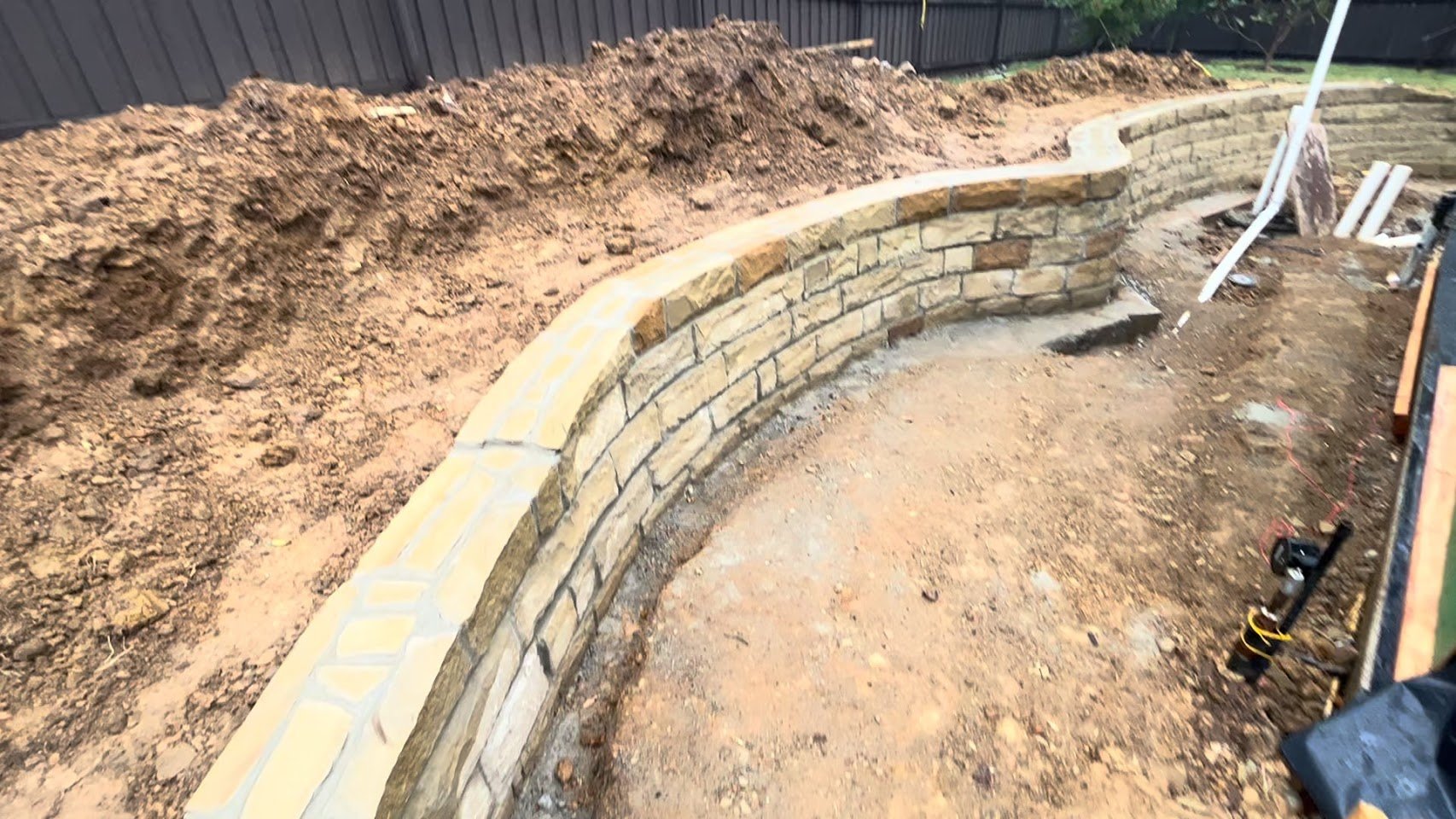
It starts with something easy to dismiss. A slight lean in the wall along the back fence line. A hairline crack running diagonally through the mortar joints. After the heavy spring rains that rolled through Keller and Southlake last season, you noticed it—and now you can't stop noticing it. Is this cosmetic? Is it serious? Do you need to call someone today, or can it wait until fall? If you're asking those questions, this guide was written for you.
Retaining wall failure is one of the most common—and most misunderstood—structural problems facing North Texas homeowners. The DFW metroplex has a unique combination of expansive clay soil, extreme weather cycles, and aging housing stock that makes retaining walls fail faster and more often than almost anywhere else in the country. The good news: when you understand what's actually happening and what to do about it, you can make smart, confident decisions instead of panicking or procrastinating.
This guide covers everything—the geology behind why walls fail, how to read the warning signs, what repairs actually cost in 2026, what the permit rules require, how to vet contractors, and how to avoid the predatory practices that plague this market. Let's get into it.
Key Takeaways
- North Texas's expansive montmorillonite clay causes seasonal ground movement of 3–6 inches—far more than most older walls were built to handle.
- 80% of retaining wall failures are caused by inadequate drainage and hydrostatic pressure, not structural defects. Fix the water problem first.
- DFW repair costs run 15–25% higher than the national average due to over-excavation requirements and imported crushed limestone backfill.
- Any retaining wall 48 inches or taller requires a building permit and a PE-stamped repair plan in most DFW municipalities.
- A $4,000 drainage repair today can prevent a $25,000+ full demolition and rebuild tomorrow—and homeowners insurance almost never covers wall failure.
- 70% of contractors advertising "retaining wall repair" are general landscapers; only about 10% are dedicated masonry specialists with structural engineering expertise.
- Proper engineered repairs—with drainage correction, geogrid reinforcement, and clean gravel backfill—should last 50–100 years with minimal maintenance.
Why Retaining Walls Fail So Quickly in North Texas
If your retaining wall is failing, you didn't do anything wrong. The problem isn't your wall—it's the ground underneath it. The Dallas-Fort Worth metroplex sits atop the Blackland Prairie formation, a geological zone dominated by montmorillonite clay (also called smectite clay). According to Texas A&M AgriLife Extension, this clay has a Plasticity Index (PI) of 35–55, which is classified as "highly expansive." That means it absorbs water and swells dramatically—then shrinks and cracks as it dries out.
The seasonal ground movement in DFW averages 3 to 6 inches of Potential Vertical Rise (PVR). That's not a typo. The ground your retaining wall is anchored into is literally moving several inches up and down every year. Older walls—especially those built during the 1990s and early 2000s suburban building boom—were never engineered to handle this level of constant movement. They're now reaching the end of their 20–30 year lifespans, and the soil is winning.
Understanding masonry failures in the DFW area starts with understanding this geology. It's not a fluke that your neighbor's wall failed last spring and yours is showing cracks now. It's the predictable result of highly engineered soil doing exactly what it does—and walls that weren't built to compensate for it.
The Hydrostatic Pressure Problem
Here's the physics of why walls fail. When DFW clay absorbs water during spring rains, it doesn't just get heavier—it expands laterally, pushing outward against anything in its path. A retaining wall is exactly in its path. The force exerted by saturated, expanding clay is enormous—measured in hundreds of pounds per square foot.
The engineering solution to this problem is well-established: install 12 to 24 inches of clean, angular crushed gravel (specifically #57 crushed limestone) directly behind the wall. This gravel layer drains water downward and away before it can saturate the clay and build pressure. The problem is that most walls built before 2010 in DFW were backfilled with native clay—the same expansive material that was just excavated. It was cheaper and faster. It also means those walls have been fighting a losing battle against hydrostatic pressure every single rainy season.
Without proper drainage, the wall bears the full lateral force of expanding, water-saturated mud. Eventually, something gives—a crack forms, a block shears, the wall bows outward. Engineering industry data from the National Concrete Masonry Association (NCMA) and the Federal Highway Administration (FHWA) confirms that 80% of all retaining wall failures trace back to this exact problem: inadequate drainage and hydrostatic pressure.
Why DFW Is Different From Other States
Homeowners who've lived in other states sometimes wonder why their retaining wall held up fine in Georgia or Colorado but is failing here. The answer is soil. Sandy or loamy soils drain naturally and don't expand when wet. DFW clay does both—it holds water and swells. Then when the summer heat arrives and temperatures hit 105°F+, it dries out and shrinks, creating voids and pulling away from the wall base. This constant wet-dry cycle is uniquely destructive.
The practical consequence is that retaining wall repairs in DFW cost 15–25% more than the national average. Every repair requires heavy over-excavation to remove native clay and replace it with imported clean #57 crushed limestone. Trucking tons of gravel to a Keller or Southlake backyard adds real cost. Stricter 2021 IBC codes now require geogrid reinforcement and PE-stamped plans for walls over 4 feet, adding engineering fees that weren't required a decade ago.
Warning Signs Your Retaining Wall Is About to Fail
Knowing what to look for is the difference between a $4,000 repair and a $25,000 emergency rebuild. Most retaining walls give clear warnings before catastrophic failure—if you know how to read them. Grab a level, walk your wall, and check for these indicators.
- Visible lean or bowing outward: Hold a level against the wall face. If the wall is more than 2 inches out of plumb, that's structural distress—not cosmetic.
- Horizontal cracks across masonry joints: Especially in a stair-step pattern, these signal shear stress from soil movement. Stair-step cracks in brick and masonry are a specific failure mode with well-documented causes and repair methods.
- Wall separating from adjoining structures: If the wall is pulling away from a fence, patio, or home foundation, that's differential settlement—the wall and adjacent structure are moving at different rates. Imminent failure.
- Sinkholes or standing water behind the wall: These are drainage failure indicators. If water is pooling directly behind the wall, hydrostatic pressure is building right now.
- Clogged or missing weep holes: Weep holes at the base of the wall are designed to let trapped water escape. If they're packed with mud, water has nowhere to go except into the wall structure.
- Bulging sections that worsen after rain: If you notice the bowing gets worse after a heavy storm and then partially recovers, that's active hydrostatic failure in real time.
The Urgency Scale: When to Call a Professional Immediately
⚠️ Immediate (within 48 hours): Wall leaning more than 2 inches out of plumb, large horizontal cracks running across the full width of the wall, or visible separation from adjacent structures. These are pre-collapse indicators. Don't wait.
⏰ Urgent (within 1–2 weeks): Moderate bowing (1–2 inches), clogged weep holes, standing water behind the wall. The wall is under stress but hasn't reached the failure threshold yet.
📅 Routine (schedule within 4–8 weeks): Minor surface cracks, slight discoloration, cosmetic mortar deterioration with no structural movement. Still worth addressing before next rainy season.
If you're unsure which category your wall falls into, err toward urgency. A professional assessment takes a couple of hours and gives you a clear answer. Waiting and guessing is how a manageable repair becomes an emergency rebuild.
Understanding Retaining Wall Repair Costs in DFW
One of the most frustrating parts of facing a failing retaining wall is having no idea what it's going to cost. Contractors are often reluctant to give ballpark numbers over the phone, and the range between a minor repair and a full rebuild is enormous. Here's what the 2026 DFW market actually looks like, broken down by repair scope.
For detailed regional pricing context, the cost breakdown for brick and stone repair in Fort Worth provides a useful baseline for understanding how material and labor costs stack up across the metroplex.
- Entry-level repairs (mortar, tuckpointing, minor drainage fixes): $800–$2,500. Appropriate for cosmetic surface cracking with no structural movement and functional existing drainage.
- Mid-range repairs (crack patching, helical tie-backs, French drain installation): $3,000–$7,500. For walls with moderate bowing, drainage failure, or early structural distress that hasn't reached the point of full replacement.
- Premium repairs (partial to full rebuild): $10,000–$30,000+. Required when the wall has bowed past the point of correction, experienced structural block failure, or collapsed. DFW pricing averages $45–$85 per square face foot for full rebuilds.
Material costs—Portland cement, crushed limestone aggregate, and steel reinforcement—remain 15–20% higher than pre-2022 levels as of 2026. The skilled mason shortage has also driven labor rates up significantly, and the best contractors in DFW are typically booked 4–8 weeks out.
Hidden and Overlooked Costs
The line items that surprise homeowners most aren't the masonry work itself—they're the ancillary costs that come with a proper, code-compliant repair.
- Structural engineering assessment: $1,000–$2,500. Required for walls over 4 feet or supporting a surcharge (driveway, pool, steep slope). This is non-negotiable under current IBC code.
- City permits: $100–$500 depending on municipality and project scope.
- Landscaping restoration: Excavating behind a wall destroys turf, irrigation lines, and plantings. Budget $1,000+ to restore the area after the structural work is done.
- HOA aesthetic matching: In communities like Trophy Club or Southlake, HOAs often require specific brick or stone colors and textures. This can add 10–20% to material costs when the original product is discontinued or hard to source.
- Soil testing and geotechnical analysis: $500–$1,500 for complex sites with significant slope, surcharges, or unusual failure patterns.
Why DFW Costs More Than National Average
The national average for retaining wall repair is $20–$50 per square face foot. DFW runs $45–$85. The gap isn't contractor greed—it's geology. Every proper repair in North Texas requires removing tons of expansive native clay and replacing it with imported clean #57 crushed limestone. Trucking that material to a residential site in Roanoke or Haslet adds real cost. Add in the engineering fees required by stricter 2021/2024 IBC codes, geogrid reinforcement, and the premium labor rates driven by the skilled mason shortage, and the numbers make sense.
Trying to figure out whether your wall needs a $3,000 drainage fix or a $20,000 rebuild? A professional on-site assessment is the fastest way to get an accurate number for your specific situation—no guessing required.
Schedule a Free Consultation⚠️ Ignoring a Failing Wall Costs Thousands More Later
A $4,000 drainage and tie-back repair today can prevent a $25,000+ full demolition and rebuild tomorrow. Homeowners insurance almost never covers retaining wall failure—failures caused by "earth movement," "hydrostatic pressure," or "wear and tear" are explicitly excluded from standard policies. If the wall collapses and takes your pool or landscaping with it, you'll bear 100% of the cost.
Permits, Codes, and Licensing Requirements in North Texas
The regulatory landscape for retaining wall repair in Texas confuses a lot of homeowners—and some contractors deliberately exploit that confusion. Here's what you actually need to know.
Texas does not require a state-level masonry license. The Texas Department of Licensing and Regulation (TDLR) oversees plumbers and electricians, but masonry and retaining wall contractors are not regulated at the state level. This places the entire burden of vetting on local municipalities and consumers. Contractors must register with the city where they're working—Dallas, Fort Worth, Plano, Southlake, etc.—and carry minimum general liability insurance (typically $1 million).
Building permits are required for any retaining wall 48 inches (4 feet) or taller, measured from the bottom of the buried footing to the top of the wall. This is a stricter measurement than most homeowners realize—a wall that looks 3 feet tall above grade may be 5 feet tall when you include the buried footing, which triggers the permit requirement. Even walls under 4 feet require permits if they support a surcharge: a driveway, pool, or steep slope above the wall.
Most DFW cities currently enforce the 2021 International Building Code (IBC) and International Residential Code (IRC), with some municipalities transitioning to the 2024 editions. Under these codes, any wall over 4 feet or supporting a surcharge must have its repair plan stamped by a Texas-licensed Professional Engineer (PE). This isn't optional—it's a code requirement, and a contractor who skips it is putting you at legal and financial risk.
For additional context on how permit requirements work across DFW projects, the outdoor kitchen masonry permit requirements in DFW guide covers the regulatory framework that applies across masonry projects in the metroplex.
How to Verify Your Contractor's Credentials
Because the state doesn't license masons, you have to do the verification work yourself. Here's exactly how to do it:
- Ask for a Certificate of Insurance (COI) and verify it covers both general liability and workers' compensation. Call the insurance company directly to confirm it's current.
- Call your local city permit office and ask whether the contractor is registered to pull permits in that municipality. This takes five minutes and is the single most important verification step.
- Check the Texas Secretary of State website to verify the contractor's business registration and confirm they're in good standing.
- Look for memberships in the Mason Contractors Association of America (MCAA) or National Concrete Masonry Association (NCMA)—these indicate professional commitment to industry standards.
- Ask about manufacturer certifications: Allan Block Master Wall Builder, Belgard Authorized Contractor, and ICPI Certification all demonstrate that the crew has been formally trained in structural installation techniques.
Red Flags: What NOT to Do
Watch for these contractor red flags before signing anything:
- Refuses to pull a permit for a wall over 4 feet—this violates code and voids any warranty.
- Demands 50–100% payment upfront in cash—legitimate contractors accept checks, credit cards, and financing; standard deposits are 10–30%.
- Says "we'll just push it back and pour concrete behind it"—this ignores the drainage problem entirely and will fail within 1–2 years.
- Plans to backfill with native clay instead of importing clean #57 crushed limestone—the wall will fail again during the next heavy rain.
Repair Methods: From Band-Aids to Full Rebuilds
Not every failing retaining wall needs to be torn down and rebuilt from scratch. But not every wall can be saved with a tube of mortar, either. Understanding the spectrum of repair approaches—and what each one actually accomplishes—helps you evaluate contractor proposals and avoid paying for either too little or too much.
For a full overview of concrete and retaining wall solutions available in the DFW market, Brick & Stone Master's service page covers the modern construction and repair techniques used in North Texas today.
- Surface mortar and tuckpointing: Cosmetic fix only. Fills visible cracks without addressing drainage or structural issues. Expect 1–2 years before the same cracks reopen—or worse ones form.
- Helical tie-back anchors: Specialized fasteners drilled through the wall into stable soil behind it. Can pull a leaning wall back toward plumb without full demolition. Highly effective when the masonry is still structurally sound.
- French drain installation: Excavate behind the wall, lay perforated drain pipe at the base, backfill with #57 crushed limestone. Redirects water away before it can build hydrostatic pressure. This is the most important repair component in DFW.
- Geogrid reinforcement: Modern synthetic mesh installed horizontally in the wall structure to resist lateral earth pressure. Standard in all new construction; can be incorporated into partial rebuilds.
- Partial rebuild: Remove and replace the upper portion of the wall while keeping the lower foundation intact. Used when only the top section has failed and the base is still sound.
- Full demolition and rebuild: Complete removal and reconstruction with modern materials, proper drainage, geogrid, and PE-stamped design. Most expensive, most durable. The right choice when structural failure is severe or the wall is beyond the point of correction.
Which Repair Method Is Right for Your Wall?
The decision tree is simpler than it sounds:
- Slight lean (under 2 inches) + intact masonry + good drainage: Helical tie-backs and drainage correction. Wall can likely be saved without full rebuild.
- Moderate bowing (2–4 inches) + some cracking + poor drainage: Partial rebuild with new geogrid and French drain installation.
- Severe bowing (over 4 inches) + structural failure + crumbling masonry: Full demolition and rebuild. No amount of patching will fix this.
- Material matters: Natural stone is the most labor-intensive to repair. Segmental retaining wall (SRW) blocks are mid-range. Pressure-treated timber is no longer recommended in DFW—rot and termites make it a poor long-term choice in the North Texas climate.
The Durability Difference
The gap in longevity between repair approaches is staggering and worth understanding before you accept a low-bid proposal:
- Band-aid repairs (mortar only): 1–2 years before failure
- Drainage-only fixes: 3–5 years if the wall structure is still sound
- Proper engineered repairs (drainage + tie-backs + geogrid): 50–100 years with minimal maintenance
- Full rebuild with modern materials and design: 75–100+ years
💡 Water Is the Enemy—Fix the Drainage First
80% of retaining wall failures are caused by hydrostatic pressure from trapped water, not structural defects. Any repair that doesn't address drainage—proper gravel backfill, French drains, and functioning weep holes—will fail again within a few years. A contractor who skips the drainage work and just patches the cracks is setting you up for a repeat failure.
Finding and Vetting the Right Contractor in DFW
Here's a number that should give you pause: approximately 70% of contractors advertising "retaining wall repair" in the DFW market are general landscaping companies. Only about 10% are dedicated masonry specialists with the structural engineering background required to permanently fix a hydrostatic failure in North Texas clay. The other 20% are general contractors who do some hardscape work on the side.
Landscapers are excellent at what they do—planting, grading, irrigation, and hardscape aesthetics. But fixing a wall that's failing due to expansive clay and hydrostatic pressure requires structural engineering knowledge, not landscaping expertise. When you hire a landscaper to fix a structural masonry problem, you often get a beautiful-looking repair that fails again within a year or two.
The DFW suburbs where this distinction matters most are the ones with the highest-value properties and the most complex terrain. If you're in Southlake, Keller, Trophy Club, or Roanoke, you're dealing with walls that often support pools, elevated patios, and significant landscaping investments. The guide to top masonry contractors in Southlake and the review of masonry contractors in Trophy Club can help you identify qualified specialists in these specific communities.
Consumer research data shows that homeowners typically get 3 quotes and spend 2–4 weeks researching before making a decision. The top deciding factors are warranty terms and perceived engineering expertise—not price. That's a smart instinct. The cheapest bid is almost always the cheapest because something important is being skipped.
Questions to Ask Every Contractor
These five questions will separate qualified specialists from landscapers with a masonry crew:
- "What is causing the wall to fail, and how will you fix the underlying issue?" The correct answer involves addressing drainage, adding #57 crushed limestone backfill, and correcting the clay backfill problem. Any answer that doesn't mention drainage is a red flag.
- "Will you pull a permit and have the work inspected?" Non-negotiable for walls over 4 feet. A contractor who resists this question is telling you something important.
- "Will a PE stamp the repair design?" Required for structural walls in DFW. If they don't know what you're asking, that's your answer.
- "What warranty do you offer, and is it in writing?" Reputable masonry specialists offer 5–10 year structural warranties. Get it in writing before work begins.
- "Can you provide references from similar projects in the DFW area?" Ask for at least 3 recent projects of similar scope. Call the references.
Predatory Practices to Avoid
The Better Business Bureau consistently ranks exterior and hardscape contractors in the top 10 complaint categories in Texas. The most common complaints are "incomplete work" and "structural failure within 12 months of repair." These are the specific scams to watch for:
- The "Dirt Backfill" scam: Contractor repairs the wall but backfills with the same native expansive clay they just excavated. The wall looks perfect on day one. Then the next rainstorm comes, the clay expands, and the cycle starts again. You've paid for a repair that will fail within a year.
- The "No Permit" shortcut: Contractor skips permits to save time and money. The work doesn't meet current code, voids any warranty, creates liability issues if the wall fails, and can complicate future home sales.
- The "Cash-Only" demand: Legitimate contractors accept checks, credit cards, and financing. Cash-only is a red flag for uninsured or unlicensed operators.
- The "Quick Fix" promise: Any contractor claiming they can fix a structural wall in a single day is cutting corners. Proper excavation, drainage installation, and masonry repair on a significant wall takes days, not hours.
Ready to get a professional assessment from a contractor who specializes in DFW's unique soil and climate challenges? A free consultation gives you a clear diagnosis and honest pricing—no pressure, no guesswork.
Get Your Free Wall Assessment✅ Before You Hire: The Contractor Checklist
- Verify insurance (COI)—call the insurer to confirm it's current
- Confirm city registration with your local permit office
- Check Texas Secretary of State for business registration
- Ask about permits and PE stamps—non-negotiable for walls over 4 feet
- Request a written warranty (5–10 years for structural work)
- Call at least 3 references from similar recent projects
A reputable contractor will answer all of these questions confidently and provide documentation without hesitation.
Top Retaining Wall Repair Contractors in North Texas: Compared and Reviewed
The DFW market has dozens of firms claiming expertise in retaining wall repair. Here's an honest comparison of the major provider types—what they're good at, where their limitations are, and what differentiates the specialists from the generalists.
Brick & Stone Master
Location: 3800 Haslet-Roanoke Road Suite 32, Roanoke, Texas 76262
License/Registration: Registered with Dallas, Fort Worth, Plano, and all major DFW municipalities. Carries $2M general liability and workers' compensation insurance.
Service Area: All of Dallas-Fort Worth metroplex, including Southlake, Keller, Trophy Club, Roanoke, Haslet, Grapevine, and surrounding suburbs.
Specialties: Structural retaining wall repair and rebuild, helical tie-back installation, French drain systems, geogrid reinforcement, PE-stamped designs. View the full range of Brick & Stone Master's retaining wall services for details on their specific capabilities.
Ratings/Reviews: 4.9/5 on Google (150+ reviews); BBB A+ rating. Consistent praise for engineering expertise, transparent communication, and thorough pre-repair assessments.
Key Differentiators: In-house structural knowledge, PE stamps on all repairs over 4 feet, written 10-year structural warranty, uses only clean #57 crushed limestone backfill (never native clay), detailed pre-repair assessments with written scope of work. Notable projects include high-end residential rebuilds in Southlake and Trophy Club, commercial hardscape, and HOA-approved aesthetic matching.
Regional Masonry Firm (General Masonry Repair)
License/Registration: Registered in Dallas and Fort Worth proper; $1M general liability.
Service Area: Dallas and Fort Worth proper; limited reach into northern and western suburbs.
Specialties: General masonry repair, some retaining wall work, brick and stone restoration.
Ratings/Reviews: 4.3/5 on Google (80+ reviews); mixed feedback on structural knowledge and drainage expertise.
Notable Gaps: Does not always pull permits for walls under 5 feet; limited geogrid experience; competitive pricing makes them attractive for cosmetic repairs but less appropriate for structural failures in DFW clay conditions.
Large Landscaping Company (Full-Service Hardscape)
License/Registration: Registered in multiple DFW cities; $1M general liability.
Service Area: All of DFW metroplex.
Specialties: Landscaping, hardscape design, some retaining wall installation and repair. Strong on aesthetics and design coordination.
Ratings/Reviews: 4.1/5 on Google (200+ reviews); strong ratings for design and project management, mixed reviews on structural repairs.
Notable Gaps: Primarily landscapers, not structural engineers. Some recurring complaints about drainage issues reappearing after repair—the classic sign that native clay was used for backfill instead of #57 crushed limestone. Good for new wall installation on stable sites; less appropriate for complex structural repairs in DFW clay.
Independent Masonry Contractor (Local Craftsman)
License/Registration: Registered locally; $1M general liability.
Service Area: Limited to Dallas and immediate suburbs.
Specialties: Brick and stone masonry, decorative work, some retaining wall repair.
Ratings/Reviews: 4.5/5 on Google (60+ reviews); praised for craftsmanship on decorative and cosmetic work.
Notable Gaps: Limited structural engineering background; does not always recommend or install proper drainage systems. Excellent option for small cosmetic repairs and decorative stonework; not the right choice for structural failures or walls requiring PE stamps.
"The difference between a $4,000 repair and a $25,000 rebuild often comes down to who you hired the first time. A masonry specialist who fixes the drainage gets it right once. A landscaper who patches the cracks without addressing the water problem sends you back to square one within two years."
Step-by-Step: What to Expect During a Retaining Wall Repair
One of the biggest sources of anxiety for homeowners is not knowing what's going to happen to their property during a repair. Here's the full process, from first call to final inspection, so you know exactly what to expect.
For a broader understanding of what masonry repair projects involve in the DFW market, the guide on how much it costs to fix a brick wall in DFW provides useful context on scope, timelines, and pricing across different repair types.
- Initial assessment and quote (1–2 hours): Contractor evaluates the wall, identifies failure causes, discusses repair options and cost ranges. A quality contractor will explain what's causing the failure, not just what they plan to do about it.
- Permit and engineering (1–3 weeks): If required, contractor obtains permits and has a PE stamp the repair design. This step cannot be rushed—city permit offices have their own timelines.
- Excavation and soil removal (1–3 days): Heavy equipment removes soil behind the wall. Native clay is hauled away—this is a significant volume of material. Expect trucks and equipment in your driveway or yard.
- Drainage installation (1–2 days): Perforated drain pipe is laid at the base of the wall, surrounded by #57 crushed limestone. This is the most critical step in any DFW retaining wall repair.
- Wall repair or rebuild (3–10 days depending on scope): Masonry is repaired or rebuilt, geogrid is installed at appropriate intervals, new blocks or stone are set and mortared.
- Backfill and compaction (1–2 days): Clean gravel and engineered soil are compacted behind the wall in 6-inch lifts. This is not a step that can be rushed—proper compaction prevents future settlement.
- Landscaping restoration (1–2 days): Turf, irrigation lines, and plantings are restored. Budget separately for this—it's not always included in the masonry contract.
- Final inspection and warranty (1 day): City inspector approves the work. Contractor provides written warranty documentation. Keep this on file.
Timeline and Disruption Expectations
- Small repair (under 50 linear feet): 1–2 weeks total, minimal disruption to daily life.
- Medium repair (50–150 linear feet): 2–4 weeks total, moderate disruption—no access to the backyard during excavation phases.
- Large rebuild (over 150 linear feet): 4–8 weeks total, significant disruption with heavy equipment, noise, and dust. Plan accordingly.
- Best time to schedule: Late fall and winter (November–February) when the soil is stable and dry, and contractors are slightly less booked. Some firms offer 5–10% winter discounts to keep crews working through the slower months.
Financing Your Retaining Wall Repair
The financial reality of retaining wall repair in DFW is straightforward and uncomfortable: homeowners insurance almost never covers it. Standard policies explicitly exclude damage from "earth movement," "hydrostatic pressure," "settling," and "poor maintenance." Unless a tree fell on your wall during a storm or a vehicle drove into it, you're paying out of pocket. That means financing is a practical necessity for many homeowners facing mid-range or premium repairs.
For regional context on what masonry repairs cost in specific DFW communities, the breakdown of masonry contractor costs in Keller provides a useful reference point for homeowners in the northern suburbs.
Here are the financing options most commonly used by DFW homeowners in 2026:
- Contractor financing partnerships: Many DFW masonry contractors partner with lenders like GreenSky, Hearth, and Synchrony to offer 12–18 month 0% interest promotions. Apply at the time of signing the contract.
- Home Equity Line of Credit (HELOC): Currently the most popular option for $15,000+ rebuilds. Uses your home's equity as collateral; typically offers lower interest rates than personal loans.
- Home improvement loans: Available from banks and credit unions with 5–10 year terms at 6–10% interest. Good option if you don't have significant home equity.
- In-house payment plans: Some contractors offer 10–30% down with the remainder due upon project completion. Ask about this option during the quote process.
- Winter discounts: Scheduling repairs in January or February can yield 5–10% savings at some firms—ask directly when getting quotes during the off-season.
Don't let financing concerns delay a repair that could prevent thousands in future damage. Most DFW masonry specialists offer flexible payment plans—find out what options are available for your specific project scope and timeline.
Discuss Financing OptionsMaintenance and Long-Term Care After Retaining Wall Repair
A properly repaired retaining wall—one with correct drainage, geogrid reinforcement, and clean gravel backfill—requires virtually no maintenance and should last 50–100 years. But "virtually no maintenance" doesn't mean zero maintenance. A few simple habits will protect your investment and catch problems early if they develop.
For long-term protection beyond structural repairs, cleaning and waterproofing masonry is an important component of a complete maintenance program—especially for natural stone and brick walls exposed to DFW's weather extremes.
- Inspect weep holes annually (spring and fall). These small openings at the base of the wall are your drainage system's exit point. Clear any mud or debris with a wire brush. If water isn't flowing out of them after a heavy rain, something is blocking them.
- Monitor for new cracks or leaning after heavy rain events. Take photos after significant storms and compare them over time. A crack that's stable is different from one that's growing.
- Keep gutters and downspouts clean so roof runoff doesn't pool behind the wall. A clogged gutter can direct hundreds of gallons of water directly into the soil behind your wall during a single storm.
- Avoid planting large trees directly behind the wall. Root systems can disrupt the gravel drainage layer and push against the wall structure over time. Ornamental shrubs and groundcover are fine; large shade trees are not.
- Maintain soil clearance from the wall face. Keep at least 6 inches of clearance between the wall face and the surrounding soil surface. Soil piling against the wall face traps moisture and accelerates deterioration.
- Act immediately on standing water or erosion behind the wall. These are drainage failure indicators. If you see them, call a contractor—don't wait for the next inspection cycle.
The National Association of Realtors Remodeling Impact Report estimates that structural exterior repairs like retaining walls yield 100–150% ROI by protecting the home's foundation and maintaining the property's insurability and resale value. A wall that's maintained properly is an asset; one that's ignored becomes a liability.
Frequently Asked Questions About Retaining Wall Repair in North Texas
Can I repair a leaning retaining wall, or does it need full replacement?
It depends on the severity and the material. If the wall is leaning more than 2 inches out of plumb, or if structural blocks have snapped or crumbled, a full teardown and rebuild is usually the right call. However, if the masonry is still structurally intact and the wall is only slightly bowing, specialized contractors can excavate behind it, correct the drainage, and install helical tie-back anchors to pull the wall back toward plumb without full replacement. The key question is whether the masonry itself is still sound—a good contractor will assess this during the initial evaluation and give you an honest answer about which path makes more financial sense for your situation.
Do I need an engineer to fix my retaining wall?
Yes, if the wall is taller than 4 feet or supports a surcharge—a driveway, pool, or steep slope above the wall—a Texas-licensed Professional Engineer must stamp the repair plan under IBC code as adopted by most DFW municipalities. This isn't optional; it's a code requirement, and a contractor who skips it is putting you at legal and financial risk. For small decorative garden walls under 2 feet with no surcharge, an engineer is not required. But for any structural wall in DFW's clay soil environment, having an engineer involved is good practice regardless of the height threshold—the soil conditions here are genuinely unusual.
Is retaining wall failure covered by homeowners insurance?
In 99% of cases, no. Standard homeowners insurance policies explicitly exclude damage caused by "earth movement," "hydrostatic pressure," "settling," and "poor maintenance"—which describes virtually every retaining wall failure in North Texas. Unless a tree fell on the wall during a storm or a vehicle drove into it, you'll be paying for the repair entirely out of pocket. This is why financing options are so important to understand before you need them, and why proactive maintenance and early repair are so financially critical.
What causes retaining walls to fail so often in North Texas?
The primary culprit is the combination of highly expansive montmorillonite clay and extreme weather cycles. When it rains, DFW clay absorbs water and expands massively, exerting enormous lateral pressure against the wall. Most older walls were built without the required 12–24 inches of clean gravel backfill to drain this water away, so the wall bears the full force of the expanding, water-saturated soil until something gives. Texas A&M AgriLife Extension confirms that Blackland Prairie clay has a Plasticity Index of 35–55—classified as "highly expansive"—and seasonal ground movement in DFW averages 3–6 inches annually. No wall built without proper drainage engineering can handle that indefinitely.
How long should a retaining wall repair last?
A band-aid repair—patching mortar over cracks without fixing the underlying drainage—will fail again within 1–2 years. A proper, engineered repair that corrects the drainage problem, installs geogrid reinforcement, and uses modern concrete SRW blocks or natural stone should last 50–100 years with minimal maintenance. The longevity difference between a cheap fix and a proper repair is not incremental—it's the difference between a temporary patch and a permanent solution. This is why warranty terms are one of the most important things to evaluate when comparing contractor proposals.
Can I DIY a retaining wall repair, or should I hire a professional?
For a 2-foot decorative border wall with no structural load, DIY is perfectly reasonable. However, repairing a structural retaining wall of 3 feet or taller is genuinely dangerous and labor-intensive work. It requires moving thousands of pounds of wet clay, importing and placing tons of crushed stone, understanding lateral earth pressures, and potentially installing geogrid and helical anchors. A DIY mistake on a structural wall can lead to catastrophic collapse, property damage, or serious injury—and if the wall is over 4 feet, unpermitted work creates legal liability that can complicate your home sale or insurance claims down the road.
Ready to Fix Your Retaining Wall? Get Expert Help in North Texas
Brick & Stone Master has helped hundreds of DFW homeowners fix failing retaining walls the right way—with proper drainage, engineering, and a warranty that lasts. We understand what DFW clay does to walls, and we fix the real problem instead of patching over it.
If your wall is leaning, cracking, or bowing, don't wait for catastrophic failure. The gap between a manageable repair and an emergency rebuild closes quickly once a wall reaches the tipping point.
Contact us today for a free assessment and transparent pricing—no pressure, no upselling, just honest answers about what your wall needs and what it will cost.
Schedule Your Free Retaining Wall Consultation Today