
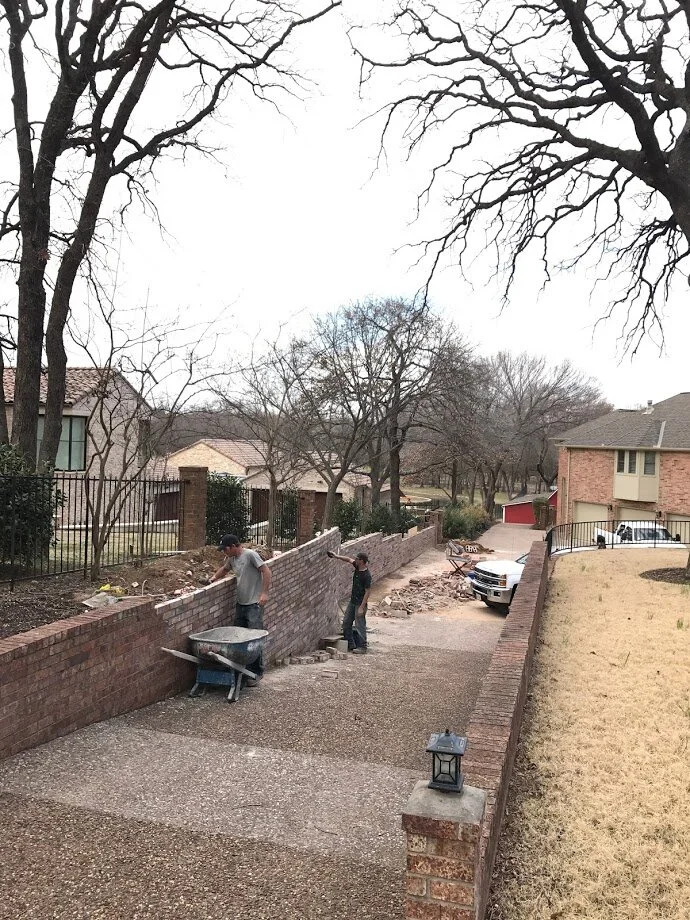
A homeowner in Southlake spends $15,000 on a retaining wall. The contractor is friendly, the price is competitive, and the wall looks great on day one. Three years later, the wall bows outward. Cracks run diagonally through the block face. The grade behind it is shifting. The contractor's phone number is disconnected. A structural engineer walks the site, shakes his head, and delivers the verdict: no geogrid, no drainage stone, native clay backfill. Demolition and proper rebuild: $35,000. The homeowner didn't cut corners — they simply didn't know what questions to ask. That's exactly what this guide is here to fix.
This is a complete, technical, and honest resource on retaining wall geogrid installation — covering specifications, engineering requirements, DFW-specific costs, permit rules, and how to evaluate contractors before you sign anything. Whether you're planning a new wall in Trophy Club, replacing a failed one in Roanoke, or trying to understand a bid you received in Keller, this guide gives you the knowledge to protect your investment.
Key Takeaways
- DFW's expansive Blackland Prairie clay — with Plasticity Index values of 35–55 — makes geogrid reinforcement non-negotiable for any wall over 4 feet tall.
- Geogrid must extend 60–70% of the wall height into the hillside (minimum 4 feet) and be placed every 2–3 block courses vertically.
- DFW retaining walls cost 15–25% more than the national average due to the volume of drainage stone required to manage expansive clay.
- Almost all DFW municipalities require a building permit and PE-stamped design for any wall 48 inches or taller — measured from the buried footing, not the exposed face.
- Using native clay as backfill instead of #57 crushed stone is the single most common cause of retaining wall failure in North Texas.
- A properly engineered geogrid wall costs only 10–15% more upfront but lasts 50+ years; a cheap unreinforced wall will fail in 3–7 years and cost 150% more to rebuild.
- Less than 15% of DFW landscaping companies have formal NCMA training or PE partnerships — vetting your contractor is critical.
Why Geogrid Matters in Dallas-Fort Worth: The Expansive Clay Problem
Before you can understand why geogrid is required — not optional — in North Texas, you need to understand what's happening beneath your feet. DFW sits atop three geological formations that make it one of the most challenging environments in the country for retaining wall construction: the Eagle Ford Shale, Austin Chalk, and Blackland Prairie. All three host high-plasticity smectite clays that behave in ways that would destroy a wall built anywhere else in the country.
The Plasticity Index (PI) is the standard measure of how much a soil's volume changes with moisture content. A PI over 20 is considered highly expansive. DFW's Blackland Prairie clays routinely test at PI values between 35 and 55. That's not just expansive — that's extreme. Seasonal ground movement, measured as Potential Vertical Rise, ranges from 3 to 6 inches annually in North Texas. To put that in context: the ground under your retaining wall is physically moving up and down several inches every year as the seasons cycle between wet and dry.
This is why our concrete and retaining walls services are engineered specifically for DFW soil conditions — not adapted from a national template. What works in sandy Florida soil or rocky Colorado terrain will fail here without proper geogrid reinforcement and drainage engineering.
Why DFW Requires More Geogrid Than Other StatesDFW's expansive clay soils move 3–6 inches seasonally. A wall in Florida's sandy soil might only need 12 inches of drainage stone; a DFW wall needs 24–36 inches. This is why DFW retaining walls cost 15–25% more than the national average. It's not a markup — it's geology.
Understanding Expansive Clay and Hydrostatic Pressure
When DFW clay absorbs moisture — during spring rains, irrigation cycles, or after a summer thunderstorm — it expands by up to 10%. That expansion doesn't happen uniformly or gently. It exerts massive lateral earth pressure against whatever is in its way. If that's your retaining wall, the force is enormous and relentless. The wall doesn't fail all at once; it bows gradually, millimeter by millimeter, until the structural threshold is crossed and the face pushes outward.
Then August arrives. The clay dries, shrinks, and cracks. Those cracks become channels for the next rain event to penetrate deeper into the soil mass. Water infiltrates, the clay expands again — harder this time — and the cycle repeats. An unreinforced gravity wall in DFW is fighting this battle every single year. According to NCMA and FHWA guidelines, approximately 75–80% of all retaining wall failures are caused by poor drainage and hydrostatic pressure buildup. In DFW, that number is almost certainly higher.
How Geogrid Creates a Unified Soil-Reinforcement System
Geogrid doesn't just reinforce the wall — it fundamentally changes what the wall is. When properly installed, horizontal geogrid layers extend 60–70% of the wall height back into the hillside, interlocking with the #57 crushed stone backfill to create a unified soil-reinforcement mass. The wall facing becomes the front face of a much larger engineered structure. The hillside itself becomes the retaining element.
High-quality geogrids interlock with crushed stone to achieve a soil-geogrid interaction coefficient (Ci) of 0.8–0.9. That means the grid and the stone function as almost a single solid mass, distributing lateral pressure across a much larger volume of soil rather than concentrating it at the wall face. Combined with a perforated drain pipe at the base and proper filter fabric to keep native clay out of the drainage zone, this system relieves hydrostatic pressure before it can build to dangerous levels.
DFW Market Context: Population Growth, Demand, and the Contractor Gap
The DFW metroplex has surpassed 8.1 million residents, and that growth is not slowing down. Development is pushing hard into the hilly, topographically varied northern and western suburbs — cities like Roanoke, Haslet, Trophy Club, Southlake, and Keller. These areas feature steep ravines, creek beds, and dramatic elevation changes that require tall, engineered retaining walls just to create buildable flat lots. The demand for properly engineered walls has never been higher.
Premium suburbs like Southlake and Trophy Club carry median household incomes of $150,000–$250,000. Homeowners in these markets are not looking for a temporary fix. They want permanent, structural solutions — engineered segmental retaining walls (SRWs) and natural stone veneer walls that complement $800,000+ homes and hold their grade for decades. If you're researching masonry contractors in Southlake and Trophy Club, you already understand that the quality bar in these communities is high.
The Native Clay Backfill TrapUsing the dirt excavated from your site to backfill behind the wall is the #1 cause of retaining wall failure in DFW. Native clay blocks drainage, expands when wet, and will physically push your wall over within 3–7 years. Always demand #57 crushed stone backfill wrapped in filter fabric — no exceptions.
Here's the problem: the market is severely underserved by contractors who actually know how to build these walls correctly. Of the hundreds of landscaping companies operating in DFW, it is estimated that fewer than 15% have the dedicated training, equipment, and PE partnerships to correctly install engineered geogrid retaining walls. There is a massive gap between companies that "stack blocks" and those that build structural soil-reinforcement systems. That gap is where homeowners get hurt financially.
Seasonal Installation Windows and Weather Constraints
North Texas allows year-round construction, but the weather dictates when conditions are optimal. Peak installation seasons for geogrid retaining walls in DFW are March through June and September through December. Summer heat regularly exceeds 100°F, which drops labor productivity and requires special hydration protocols for any poured concrete footings. Winter freeze-thaw cycles can halt compaction efforts mid-project, extending timelines unpredictably.
One thing that doesn't change with the season: material costs. Off-season pricing for crushed limestone, geogrid, and filter fabric rarely drops, so scheduling flexibility doesn't translate to cost savings. If a contractor promises a lower price by waiting until January, that's not a real discount — it's a negotiating tactic.
The Contractor Landscape: Who Actually Builds Engineered Walls
Understanding the contractor landscape helps you know who to call and who to avoid. There are three primary types of providers in DFW:
- Masonry and hardscape specialists — Companies with NCMA training, in-house PE partnerships, proper equipment, and strong workmanship warranties. These are the contractors who understand geogrid engineering at a technical level and can explain every specification decision.
- General landscapers — Often bid significantly lower but frequently skip geogrid, use inadequate drainage stone, and avoid pulling permits. The failure risk is high, and the financial consequences fall entirely on the homeowner.
- Civil engineering subcontractors — Build massive commercial highway walls for TxDOT projects. Rarely take residential jobs unless the budget exceeds $100,000.
When vetting any contractor, demand certifications: NCMA Certified SRW Installer, ICPI Certification, or manufacturer-specific training from Allan Block, Tensar, or Versa-Lok. These credentials indicate the contractor has passed structured technical courses on geogrid installation — not just watched a YouTube video.
Retaining Wall Pricing in DFW: What You'll Actually Pay
Retaining wall pricing in DFW is calculated by Square Face Foot (SFF) — wall height multiplied by wall length. This is the industry standard unit, and understanding it helps you compare bids apples-to-apples. Here's what the 2026 DFW market looks like across wall height categories:
- Under 4 feet (gravity walls, typically no geogrid): $45–$65 per SFF
- 4–8 feet (standard geogrid reinforcement): $65–$95 per SFF
- 8+ feet (heavily reinforced, engineered designs): $95–$140+ per SFF
The national average for retaining walls runs $30–$60 per SFF. DFW averages 15–25% higher, and the reason is straightforward: expansive clay requires dramatically more imported drainage stone. A wall built in sandy Florida soil might need 12 inches of drainage stone behind it. A wall in Southlake, TX may require 24–36 inches of imported #57 crushed limestone. Transporting thousands of pounds of heavy aggregate into a residential backyard in North Texas drives costs up — and that's before you account for the geogrid itself, the filter fabric, and the spoils haul-off for the excavated clay.
Our retaining wall services are priced transparently with itemized scopes of work, so you know exactly what you're paying for at every height tier.
The True Cost of a Cheap WallA $15,000 wall built without proper geogrid will fail and cost $35,000+ to demolish and rebuild. Proper geogrid installation adds only 10–15% to the initial cost but extends the wall's life from 3 years to 50+ years. The math is simple: invest in engineering now or pay triple later.
Cost Drivers: Surcharge Loads, Site Access, and Materials
Several factors push a project above the baseline price range:
- Surcharge loads: If a driveway, pool, or house foundation sits above the wall, the engineering requirements escalate significantly. Thicker geogrid, deeper excavation, and more conservative safety factors add 20–30% to the base cost.
- Site access: Narrow backyard gates requiring manual wheelbarrowing of thousands of pounds of crushed stone are a major labor cost driver. A project that would take two days with equipment access can take five days by hand.
- Material selection: Basic split-face SRW blocks are the most economical facing option. Natural stone veneers applied over a reinforced CMU core sit at the top of the price spectrum — but they're also the most durable and visually striking option available.
- Material cost escalation: Heavy aggregates and engineered geogrid from manufacturers like Tensar and Mirafi have seen 5–8% annual price increases due to fuel and transport costs. This trend continued through 2025 and is factored into 2026 estimates.
Hidden Costs That Blow Up Budgets
The line items that surprise homeowners most are the ones not listed on a landscaper's basic bid:
- Geotechnical soil report: $1,500–$3,000. Required for commercial walls, strongly recommended for large residential walls or sites with poor drainage history.
- Structural PE stamp: $1,000–$2,500. Legally required for walls over 4 feet in most DFW municipalities.
- City permit fees: $150–$600 depending on municipality.
- Spoils haul-off: $350–$500 per tandem dump truck load. Expansive clay cannot be reused as backfill — it must leave the site. A large project may generate multiple loads.
True Total Cost of Ownership: Why Cheap Walls Are Expensive
A properly engineered geogrid wall costing $25,000 will stand for 50+ years with minimal maintenance. That same $25,000 spread over 50 years is $500 per year — less than most homeowners spend on lawn care. A poorly built unreinforced wall costing $15,000 will likely fail within 3–7 years in DFW's clay soils. The demolition runs $5,000. Debris disposal adds $3,000. A proper rebuild costs $20,000 or more. Total: $28,000+ for a wall that still doesn't exist yet. That's a 150% financial penalty for cutting corners on the initial build.
Comparing quotes from multiple contractors and want to make sure you're getting a fair price for proper geogrid installation? A free consultation with our masonry team can help you understand exactly what's included in each bid — and what's missing.
Schedule a Free ConsultationGeogrid Specifications and Engineering Standards
This is where most homeowners' eyes glaze over — and where most unqualified contractors hope you'll stop paying attention. Understanding the core specifications isn't just academic; it's the difference between being able to verify your contractor's work and simply trusting them blindly. You don't need a civil engineering degree. You need to know enough to ask the right questions.
Two ASTM standards govern geogrid quality. ASTM D6637 tests Ultimate Tensile Strength (UTS) — how much pulling force the grid can withstand before it fails. ASTM D5262 tests unconfined tension creep — how much the grid permanently elongates under sustained load over time. Both matter enormously for a wall that needs to perform for 50+ years in DFW's temperature extremes.
For standard residential and light commercial walls ranging from 4 to 10 feet, engineers typically specify geogrids with a UTS of 2,000–3,500 lbs/ft. Products that meet this standard include Mirafi Miragrid 2XT and 3XT, and Tensar UX systems. These are proven performers with decades of field data behind them. Understanding the difference between these products and what can go wrong is part of why we document masonry failures and how to prevent them — because the failure patterns are predictable and preventable.
You're Not Alone in Feeling OverwhelmedRetaining wall engineering is technical and jargon-heavy. Most homeowners don't know the difference between uniaxial and biaxial geogrid, and that's completely okay. The key is hiring a contractor who does — and who can explain it clearly in plain language. If a contractor can't answer your questions confidently and specifically, that's a red flag worth acting on.
The two most critical specification rules to memorize:
- Embedment length: Geogrid must extend into the retained soil at a length equal to 60–70% of the total wall height, with an absolute minimum of 4 feet. A 10-foot wall requires geogrid layers extending at least 6–7 feet back into the hillside.
- Vertical spacing: Geogrid layers must be placed every 2–3 block courses — typically every 16–24 inches vertically. Wider spacing reduces the system's ability to distribute lateral pressure.
Uniaxial vs. Biaxial Geogrid: Choosing the Right Type
This distinction trips up a surprising number of contractors. Uniaxial geogrid has tensile strength in one direction only — it is specifically manufactured to be rolled out perpendicular to the wall face, pulling the wall back into the hillside. Biaxial geogrid has uniform strength in both directions and is designed for stabilizing flat bases like driveways, patios, and road subgrades.
Retaining walls almost exclusively require uniaxial geogrid. If a contractor installs biaxial geogrid in a retaining wall, that is not a minor substitution — it is a sign of fundamental inexperience with structural wall engineering. Manufacturer specifications clearly state the intended application for each product. Ask your contractor which product they're using and verify it against the manufacturer's published application guide.
Drainage Stone and Filter Fabric: The Unsung Heroes
The geogrid gets all the attention, but the drainage system is equally critical. The zone directly behind the wall — 12–24 inches wide — must be filled entirely with clean, crushed angular stone (#57 gravel). This stone allows water to move freely downward to the perforated drain pipe at the base, which channels it away from the wall face and out to daylight or a sump.
Non-woven filter fabric wraps the drainage stone to prevent native clay from migrating into the stone over time and clogging it. This is not optional. Without filter fabric, DFW's fine clay particles will gradually infiltrate the drainage stone, reducing its permeability until it functions like a solid clay mass — and the hydrostatic pressure it was supposed to relieve begins building again.
Compaction and Base Preparation Requirements
The base of the wall must be excavated to undisturbed native soil or compacted to 95% Standard Proctor density. Every geogrid layer must be placed on a level surface — uneven placement creates stress concentrations that compromise the entire system. Critically, each layer of geogrid must be tensioned (pulled taut) during installation. A slack geogrid does not interlock properly with the surrounding stone and provides a fraction of its designed tensile resistance. This is one of the most common shortcuts taken on job sites, and it's invisible once the wall is complete.
Permits, Codes, and Legal Requirements in DFW
Texas does not require a statewide general contractor or masonry license. The Texas Department of Licensing and Regulation (TDLR) oversees electricians, plumbers, and HVAC technicians — but has zero jurisdiction over retaining wall contractors. This is not a loophole; it's simply how Texas law is structured. The consequence is that the responsibility for vetting contractors falls entirely on local city registration systems and on you as the consumer.
What does exist — and what is strictly enforced in most DFW municipalities — is the building permit requirement. Almost every city in the metroplex, including Dallas, Fort Worth, Frisco, Roanoke, and Southlake, requires a building permit for any retaining wall 48 inches (4 feet) or taller. The measurement is critical: height is calculated from the bottom of the buried footing to the top of the wall, not just the exposed face above grade. A wall showing 3.5 feet above ground with a 6-inch buried footing still triggers the 4-foot permit threshold.
Navigating these requirements is similar to the process for other structural masonry projects — our outdoor kitchen masonry permit guide for DFW walks through the general permit process that applies across most DFW municipalities, and the same principles apply to retaining walls.
International Building Code (IBC) Section 1807.2 and IRC Requirements
Under IBC Section 1807.2, retaining walls that are not laterally supported at the top and that retain more than 48 inches of unbalanced fill require a design prepared by a Texas-licensed Professional Engineer. Recent 2021 and 2024 code adoptions by DFW municipalities have tightened requirements around three key stability calculations: sliding (safety factor of 1.5 required), overturning (safety factor of 1.5 required), and global stability of the entire soil mass. Engineers must also verify the soil-geogrid interaction coefficient (Ci) through manufacturer data or site-specific testing.
One important exception that catches homeowners off guard: if a wall is under 4 feet tall but supports a surcharge — a sloping grade, a fence, a structure, or vehicular traffic — a PE stamp and permit are still legally required. The surcharge changes the lateral earth pressure calculation entirely, regardless of wall height.
Insurance, Bonding, and Contractor Verification
Before signing any contract, verify that the contractor carries a minimum of $1,000,000–$2,000,000 in General Liability Insurance and has active Workers' Compensation or occupational accident coverage. Request the certificate of insurance directly from the contractor's insurance provider — not just a copy from the contractor — and verify that the policy is current. Also confirm with the city that the contractor has pulled permits under their actual business name, not a shell company or a subcontractor's license.
Consumer Recourse for Failed Walls
The Texas Residential Construction Commission (TRCC) was abolished in 2009, removing the state mediation layer that once existed for construction disputes. Today, if a contractor's negligence causes a wall failure, your primary legal avenue is the Texas Deceptive Trade Practices Act (DTPA). If a contractor promised engineered geogrid in the contract but omitted it during installation, you can sue for treble (triple) damages under the DTPA. This makes documentation critical: keep all photos, emails, contracts, permits, and PE stamps. If the wall fails, that paper trail is your case.
Ready to move forward with your retaining wall project? Our team specializes in engineered geogrid installation across DFW and handles everything from site assessment to permit approval to final installation — so you're never left guessing.
Get Your Free Site AssessmentRed Flags: How to Spot an Unqualified Contractor
The most dangerous contractor in DFW isn't the one who does obviously bad work. It's the one who does work that looks fine for two years before catastrophically failing. Knowing what to look for before you sign a contract is the only protection you have. Here are the specific red flags to watch for:
- "Geogrid is just a suggestion — you don't need it if the wall is only 5 feet tall." Geogrid is mandatory for walls over 4 feet in DFW. Anyone telling you otherwise either doesn't understand the engineering or is trying to cut costs at your expense.
- "We can use the dirt we dig out to backfill behind the wall and save you money." Native clay backfill guarantees failure in North Texas. This is not a cost-saving measure — it's a structural death sentence.
- The contractor avoids pulling permits or suggests you "don't need one." This leaves you legally liable if the wall fails or if the city discovers the unpermitted structure during a future sale or inspection.
- The contractor cannot explain geogrid spacing, embedment length, or what type of grid they use. These are basic questions. A qualified contractor answers them immediately and specifically.
- No certifications and no references from similar projects. NCMA, ICPI, Allan Block, Tensar, and Versa-Lok all offer contractor certification programs. The absence of any credential is a meaningful warning sign.
When evaluating bids, it also helps to look at how other qualified contractors in the region operate. Our guide to the top masonry contractors in DFW covers what separates qualified firms from the rest of the market.
How to Spot a Contractor Who Cuts CornersAsk your contractor to explain geogrid embedment length, drainage stone depth, and the type of geogrid being used. If they give vague answers or say "it doesn't really matter," walk away. A qualified contractor can explain exactly why each specification matters for your specific soil conditions and site geometry — without hesitation.
Questions to Ask Before Hiring
Four questions that separate qualified contractors from the rest:
- "What are your geogrid spacing requirements, and what type of geogrid do you use?" The correct answer: uniaxial grid (such as Miragrid 2XT, Stratagrid, or Tensar UX), placed every 2–3 block courses.
- "What material do you use for backfill?" The correct answer: #57 crushed clean stone, wrapped in non-woven filter fabric. Any mention of using excavated native soil is disqualifying.
- "Can you show me your PE stamp and the permit for this project?" Legitimate contractors have these ready and pull permits under their own business name.
- "What is your warranty, and what does it cover?" Reputable contractors offer 10–25 year warranties on materials and workmanship. Vague or verbal warranties are not warranties.
The "Bait and Switch" Geogrid Scam
This is one of the most financially damaging contractor practices in the DFW retaining wall market. An unscrupulous contractor bids the job specifying proper geogrid embedment — say, 6 feet into the hillside — to win the contract at a competitive price. During installation, they install 2-foot strips instead, saving themselves significant excavation time and material cost. The wall looks identical from the outside. It passes a visual inspection. And it fails within 2–3 years when the inadequate geogrid cannot handle DFW's seasonal soil movement.
The only protection against this is a detailed, written scope of work that specifies geogrid type, vertical spacing, embedment length, drainage stone depth, filter fabric specifications, and drain pipe placement. If it's not in writing, it doesn't exist.
Step-by-Step Geogrid Installation Process
Understanding the installation sequence allows you to monitor your contractor's work in real time — not just evaluate the finished product. Each step has a purpose, and skipping or shortcutting any of them compromises the entire structural system. Here is what a properly executed geogrid retaining wall installation looks like from start to finish.
Step 1: Excavation and spoils removal. The native expansive clay must be excavated and hauled off-site. This is not optional and not cheap — each tandem truck load costs $350–$500 — but it is non-negotiable. The clay cannot be reused as backfill anywhere in the drainage zone.
Step 2: Base preparation. The base is excavated to undisturbed native soil or compacted to 95% Standard Proctor density. This is the foundation of the entire system. An improperly prepared base causes differential settlement that can crack and displace the wall regardless of how well the geogrid is installed above it.
Step 3: Drain pipe installation. A perforated drain pipe is installed at the base of the wall with a positive slope toward daylight or a sump. This pipe is the pressure relief valve for the entire drainage system. Without it, water accumulates at the base of the wall and creates hydrostatic pressure that no geogrid can overcome.
Step 4: First course of blocks. The first block course is placed on the level, compacted base. Each block must be perfectly level and plumb — errors here compound with every course above.
Step 5: Drainage stone and filter fabric. #57 crushed stone wrapped in non-woven filter fabric is placed behind the first course. This drainage zone is built up as the wall rises, maintaining a consistent 12–24 inch depth behind the block face.
The terrain in areas like Roanoke and Haslet — with their steep ravines and dramatic grade changes — makes proper execution of each step especially critical. Our work in stone and brick masonry in Roanoke and Haslet reflects years of experience navigating exactly these site conditions.
Geogrid Placement and Tensioning
After every 2–3 block courses, the geogrid layer is installed. The roll is unrolled perpendicular to the wall face, extending the full specified embedment length — 60–70% of wall height — into the hillside. The grid must be tensioned (pulled taut) to ensure proper soil-grid interaction. A slack grid is not anchored into the soil mass and provides a fraction of its designed resistance. This tensioning step takes only a few minutes but is frequently skipped on rushed job sites.
The geogrid is secured to the block face using manufacturer-specified fasteners — typically plastic pins or adhesive, depending on the block system. Adjacent geogrid layers should overlap by at least 12 inches to ensure continuity of reinforcement across the full wall length. Gaps in coverage create weak points that will show up as bowing or cracking years later.
Drainage Stone and Filter Fabric Installation
The non-woven filter fabric is wrapped around the #57 crushed stone in the drainage zone to prevent native soil migration. The stone should be compacted lightly — enough to achieve stability, but not so aggressively that the drainage capacity is reduced. The perforated drain pipe must be fully embedded in the drainage stone and maintain a consistent slope toward its outlet. An improperly sloped drain pipe allows water to pond at low points, defeating the entire drainage system.
Finishing and Compaction
Once the wall reaches full height, the remaining area behind the drainage zone is backfilled with native soil or engineered fill, compacted in 6-inch lifts to 90–95% Standard Proctor density. The finished grade must slope away from the wall to direct surface water away from the structure. A cap or coping course is installed on top of the wall to protect the block from weathering and to provide a finished appearance. This final detail also prevents water from infiltrating the block cores from above.
Proper geogrid installation is the difference between a 50-year asset and a 3-year liability. Our certified installers follow NCMA standards and provide detailed documentation of every step — so you know exactly what was built and how.
Learn About Our Installation ProcessGeogrid Materials and Manufacturers: What's Available in DFW
Not all geogrids are created equal, and material selection matters more in DFW's climate than in most other regions. The extreme temperature swings — below freezing in winter, above 100°F in summer — stress geogrid over decades of service. Low-quality grid may experience creep (permanent elongation under sustained load), gradually losing its tensile resistance until the wall begins to move. ASTM D5262 creep testing exists precisely to screen out materials that will degrade under long-term loading in conditions like DFW's.
The major manufacturers with proven track records in North Texas include:
- Tensar UX Series: High-strength uniaxial geogrid with excellent soil-grid interaction coefficients. Widely available through DFW distributors and commonly specified by structural engineers on residential and commercial projects.
- Mirafi Miragrid 2XT and 3XT: Proven performers for residential and light commercial walls. Excellent creep resistance and a long field history in expansive soil environments.
- Stratagrid: Manufacturer-specific grid used with Allan Block and other SRW systems. Performs well in expansive soils and is commonly specified in DFW residential projects.
- Versa-Lok and Keystone proprietary systems: These manufacturers produce geogrid specifically engineered to work with their block systems, ensuring optimized soil-grid interaction coefficients.
All of these products meet ASTM D6637 for tensile strength and ASTM D5262 for creep resistance. When our team at Brick & Stone Master specifies materials, we match the geogrid product to the specific wall height, soil conditions, and surcharge loads — not just to whatever is cheapest or most readily available. Our design and engineering services for masonry projects include this material specification process as part of every engineered wall project.
Why Material Quality Matters in DFW's Climate
DFW's climate is not forgiving to substandard materials. A geogrid that performs adequately in a moderate climate may experience accelerated creep and degradation when subjected to 50+ years of North Texas temperature cycling. This is why specifying products with published creep test data — not just tensile strength data — is important for any wall expected to last decades.
Reputable contractors specify geogrid from manufacturers with documented performance histories. Generic or unbranded "discount" grids may meet minimum tensile strength requirements on the day of installation but lack the creep resistance data to guarantee long-term performance. Over a 50-year service life, that difference matters enormously.
Drainage Stone and Filter Fabric Specifications
#57 crushed limestone is the standard drainage stone in DFW. It is angular (which means it compacts to a stable, interlocking mass), drains well, and is locally available at reasonable cost. Non-woven filter fabric for drainage zones is typically specified at 4–6 oz/sq yd — heavy enough to filter fine clay particles without restricting water flow.
Two materials that should never appear in a retaining wall drainage zone: woven geotextile fabric (it clogs and traps water over time) and rounded river rock or recycled asphalt (both retain water rather than draining it efficiently). If you see either of these materials on a job site, ask your contractor to explain the substitution — and be skeptical of the answer.
Common Geogrid Installation Mistakes and How to Avoid Them
The five most common installation mistakes in DFW retaining wall construction are all preventable — but only if you know to look for them. Each one is invisible once the wall is complete, which is why understanding them before construction begins is the only practical protection.
- Using native clay as backfill instead of #57 crushed stone. This is the single most common cause of wall failure in North Texas. Clay blocks drainage, expands when wet, and creates the exact hydrostatic pressure the drainage system is designed to prevent. There is no engineering fix for this mistake after the wall is built.
- Inadequate geogrid embedment length. Grid that extends only 2–3 feet into the hillside instead of the required 4–7+ feet cannot anchor the wall into stable soil. The wall appears fine initially but fails progressively as seasonal soil movement accumulates.
- Slack or improperly tensioned geogrid. Grid that is not pulled taut during installation does not interlock properly with the surrounding stone. It provides a fraction of its designed tensile resistance and allows movement that a properly tensioned grid would prevent.
- Omitting the perforated drain pipe or installing it without proper slope. Water accumulates at the base of the wall, hydrostatic pressure builds, and the wall fails — often suddenly after a heavy rain event.
- Skipping the non-woven filter fabric. Without filter fabric, DFW's fine clay particles migrate into the drainage stone over years, gradually clogging it until the drainage zone functions like a solid clay mass.
These failures don't just affect retaining walls — they create broader structural problems for the surrounding masonry and hardscape. If you're seeing signs of movement or cracking in existing masonry, our guide on how to fix stair-step cracks in brick walls covers the diagnostic and repair process for structures affected by soil movement and poor drainage.
Monitoring Your Wall During and After Installation
During installation, you have the opportunity to verify the work directly. Check that geogrid is placed every 2–3 courses and extends the full specified length into the hillside. Confirm that the material being placed in the drainage zone is clean, angular crushed stone — not native clay or rounded rock. If you're not sure what #57 crushed stone looks like, ask the contractor to show you the delivery ticket from the stone supplier.
After installation, look for a daylighting drain pipe or weep holes at the base of the wall — evidence that a drainage system was installed. Monitor the wall face during the first year, particularly after heavy rain events and during the dry summer months. Bowing, cracking, or bulging in the first year are signs of engineering failure, not normal settling. Address them immediately — the longer a failing wall is left in place, the more expensive the repair becomes. You can also explore our masonry repair services if you're dealing with an existing wall that shows signs of distress.
Long-Term Maintenance to Extend Wall Life
A properly engineered geogrid wall requires minimal maintenance, but "minimal" is not "zero." Inspect the drain pipe outlet annually to ensure water flows freely away from the wall — debris and root intrusion can block the outlet over time. Inspect the wall face each spring and fall for cracks, displacement, or signs of water seepage. Maintain proper grading around the wall to direct surface water away from the structure, not toward it. And avoid planting trees or large shrubs directly behind the wall — root systems can disrupt the soil-geogrid interface over decades, creating pathways for water infiltration and reducing the system's structural integrity.
Frequently Asked Questions About Retaining Wall Geogrid Installation
In most cases, a 3-foot wall is classified as a gravity wall and relies on its own mass to resist lateral earth pressure — geogrid is not strictly required by building code at this height. However, if there is a surcharge above that wall — a steep slope, a driveway, or a structure — geogrid becomes necessary to handle the additional lateral earth pressure that the surcharge creates. In DFW's expansive clay environment specifically, some structural engineers recommend installing a single layer of geogrid even on 3-foot walls to prevent the long-term shifting and cracking that DFW's seasonal soil movement causes over time.
This is a primary cause of retaining wall failure in Texas and one of the most serious red flags you can encounter on a job site. Native DFW clay soil blocks water from draining, turns into heavy, saturated mud, and expands dramatically as it absorbs moisture — exerting the exact hydrostatic pressure the drainage system is designed to prevent. Industry specifications and NCMA guidelines mandate that the drainage zone (the 12–24 inches directly behind the wall face) must be filled entirely with clean, crushed angular stone — #57 gravel — wrapped in non-woven filter fabric. If you see native clay going back into the drainage zone, stop the work immediately and demand a correction before proceeding.
Geogrid can absolutely be used with natural stone walls, but the engineering approach differs from segmental concrete block construction. The most common method in DFW is to build a reinforced concrete masonry unit (CMU) core wall with geogrid pinched in the mortar joints, then apply natural stone to the front face as a decorative veneer. This gives you the structural integrity of an engineered geogrid system with the aesthetic of natural stone. Building a dry-stacked natural boulder wall with geogrid is technically possible but much harder to engineer accurately, as the irregular geometry makes it difficult to calculate consistent soil-grid interaction values.
Uniaxial geogrid has tensile strength in one direction only and is specifically manufactured for retaining wall applications — it is rolled out perpendicular to the wall face to pull the wall back into the hillside, resisting the lateral earth pressure that would otherwise push the wall forward. Biaxial geogrid has uniform strength in both directions and is designed for stabilizing flat bases such as driveways, patios, and road subgrades. Using biaxial geogrid in a retaining wall is a sign of contractor inexperience with structural wall engineering; the products are not interchangeable, and manufacturer specifications clearly state the intended application for each type.
The standard engineering rule of thumb, as defined by both the NCMA and the Federal Highway Administration (FHWA), is that geogrid should extend into the retained soil at a length equal to 60–70% of the total wall height, with an absolute minimum embedment length of 4 feet regardless of wall height. A 6-foot wall therefore requires geogrid layers extending at least 4 feet into the hillside; a 10-foot wall requires 6–7 feet of embedment. In DFW's expansive clay soils or on sites with surcharge loads, engineers frequently specify embedment lengths beyond the minimum to provide additional safety margin against the soil movement that North Texas conditions create.
Yes — building codes apply to private backyards exactly as they apply to front yards and public-facing structures. In almost all DFW municipalities, any retaining wall measuring 48 inches or taller — measured from the bottom of the buried footing to the top of the block, not just the exposed face above grade — requires a city permit, plan review, and a PE-stamped design. Failure to obtain a permit can result in the city ordering you to demolish the wall at your own expense, and an unpermitted retaining wall will flag on a home inspector's report when you attempt to sell the property, potentially delaying or killing the sale.
Getting Started: How to Plan Your Geogrid Retaining Wall Project
You now have the technical knowledge to evaluate contractors, understand specifications, and protect your investment. Here's how to translate that knowledge into action with a clear, step-by-step planning process.
- Assess your site. Measure the wall height (from the lowest point of the buried footing to the top), the total wall length, and the slope of the grade behind the wall. Identify any surcharge loads — driveways, structures, fences, or steeply sloping grades — that will affect the engineering requirements.
- Get a geotechnical soil report. For walls over 6 feet, walls near structures, or sites with a history of poor drainage or soil movement, a geotechnical report ($1,500–$3,000) is money well spent. It gives your engineer the soil data needed to design the wall accurately rather than relying on conservative assumptions.
- Request quotes from at least three qualified contractors. Verify certifications (NCMA, ICPI, or manufacturer-specific training), check insurance certificates directly with the insurer, and confirm the contractor has pulled permits under their own business name on previous projects.
- Review the scope of work in detail. Confirm that the written scope specifies geogrid type, vertical spacing, embedment length, drainage stone depth and material, filter fabric specifications, drain pipe placement, and PE stamp. If any of these items are absent from the written scope, ask why — and get the answer in writing.
- Verify the permit process. Confirm that the contractor will pull the building permit under their name, obtain the PE-stamped design, and schedule the required city inspections. Never accept a contractor's assurance that permits "aren't necessary" for your specific project.
When you're ready to move forward, our retaining wall services in DFW cover the full process from initial site assessment through final installation and permit closeout. We work across the entire metroplex, with deep experience in the expansive clay conditions that make North Texas retaining wall engineering uniquely challenging.
Questions to Ask During the Consultation
Use your initial consultation to evaluate the contractor's depth of knowledge and their familiarity with your specific site conditions:
- How many years of experience do you have building geogrid retaining walls specifically in DFW — not just retaining walls generally?
- Can you provide references from projects with similar wall height, soil type, and surcharge conditions to mine?
- What is your process for handling permits, PE design, and city inspections? Do you manage that in-house or subcontract it?
- What warranty do you offer, what does it specifically cover, and how do I make a warranty claim if I need to?
A contractor who answers these questions confidently, specifically, and without hesitation is demonstrating the kind of expertise that translates into a wall that lasts 50+ years. A contractor who deflects, generalizes, or seems unfamiliar with the technical specifics is telling you something important — listen to it.
Ready to Build a Retaining Wall That Lasts 50+ Years?
You've done the research. You understand the specifications, the permit requirements, the red flags, and the real cost of cutting corners in DFW's expansive clay environment. Now the most important step is making sure the contractor you hire actually executes all of it correctly.
Brick & Stone Master has been building engineered retaining walls in Dallas-Fort Worth for years, serving homeowners and builders across Southlake, Trophy Club, Roanoke, Haslet, Keller, and the broader metroplex. We handle everything — from geotechnical assessment to PE design to permit approval to final installation — so you're never left navigating this process alone.
Let's make sure your wall is built right the first time. Our team is located at 3800 Haslet-Roanoke Road Suite 32, Roanoke, Texas 76262, and we're ready to walk your site, answer your questions, and give you a transparent, detailed proposal.
Schedule Your Free Geogrid Retaining Wall Consultation Today