
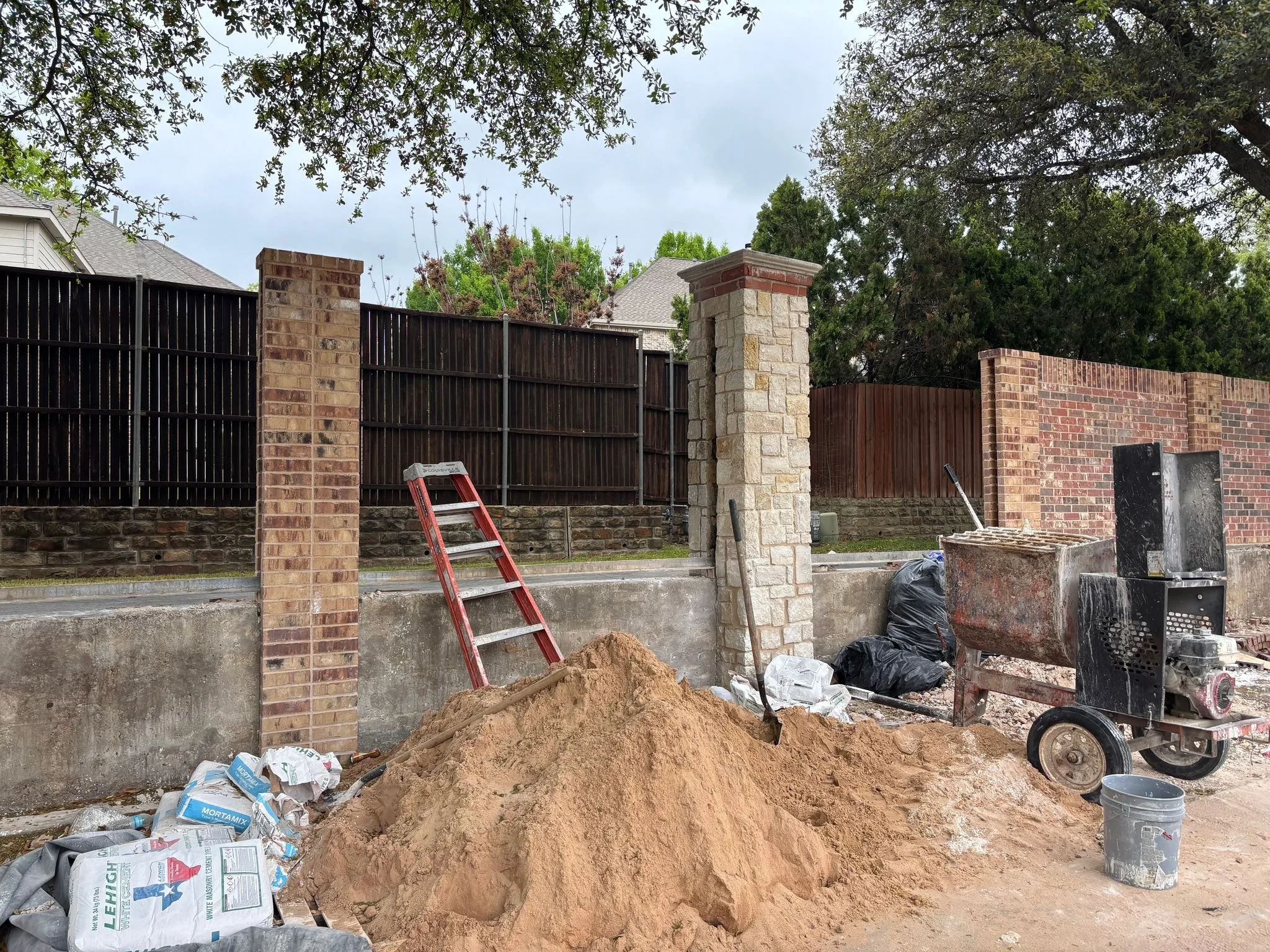
An HOA board in a fast-growing Roanoke suburb gets their first bid for a 200-linear-foot perimeter screening wall: $150,000. The board president stares at the number, unsure whether to sign the contract, reject it outright, or start over with a different contractor. Is $750 per linear foot reasonable? Outrageous? Somewhere in between? Without a clear understanding of what drives screening wall costs in North Texas, there's no way to know.
That's exactly the situation thousands of HOA boards and homeowners across the DFW metroplex find themselves in every year. Screening walls are a significant investment—one that touches HOA regulations, local building codes, soil engineering, material selection, and long-term property values all at once. The pricing can feel opaque, the contractor landscape can feel overwhelming, and the stakes are high enough that making the wrong call is genuinely costly.
This guide is designed to change that. Whether you're an HOA board in Haslet evaluating your first perimeter wall project, a homeowner in Keller looking to screen your HVAC equipment and trash enclosure, or a property manager in Northlake trying to understand why bids vary so dramatically—you'll find clear, honest answers here. We'll walk through actual cost ranges, the factors that push prices up or down in DFW specifically, material trade-offs, permitting requirements, contractor red flags, and long-term maintenance expectations.
Key Takeaways
- DFW screening wall costs range from $40–$70/LF for basic CMU block to $150–$300+/LF for premium natural stone, with brick veneer over CMU in the $70–$150+/LF mid-range.
- DFW pricing runs higher than Texas and national averages due to expansive clay soils, engineered foundation requirements, high contractor demand, and stringent HOA standards.
- Hidden costs—soil testing, engineering drawings, permits, grading, and irrigation relocation—can add $5,000–$15,000+ to a project budget if not planned for upfront.
- Most DFW cities require building permits and stamped engineering drawings for walls over 6–7 feet; verify before design begins.
- HOA architectural guidelines often specify approved materials, colors, and heights—always confirm requirements before finalizing any design.
- Reputable contractors often have 6–12+ month backlogs; start planning early to secure your preferred timeline and pricing.
- Well-built masonry screening walls can last 50–100+ years with minimal maintenance, making them a strong long-term investment in DFW's competitive market.
Why DFW Homeowners & HOAs Are Investing in Screening Walls Now
The Dallas-Fort Worth metroplex has surpassed 8 million residents and shows no signs of slowing down. Suburbs like Roanoke, Haslet, Northlake, Keller, and Trophy Club are among the fastest-growing communities in the entire country, with new master-planned developments breaking ground every month. That growth has a direct, measurable effect on the demand for screening walls—and on the cost to build them.
As lot sizes in new developments shrink and homes are built closer together, privacy becomes a genuine quality-of-life issue. A six-foot masonry wall between your backyard and a neighbor's property—or between your community and a busy arterial road—isn't a luxury. It's a practical necessity. Add to that the growing number of HOA communities that mandate masonry perimeter walls as a condition of architectural consistency, and you have a market where demand consistently outpaces qualified contractor capacity.
HOA regulations are a major driver. Many master-planned communities in Tarrant and Denton counties require masonry screening walls for utility concealment—trash enclosures, HVAC equipment, pool equipment—as well as for perimeter aesthetics. These aren't optional upgrades; they're written into the CC&Rs and enforced by architectural review committees. Homeowners who ignore them face fines, forced remediation, and potential resale complications.
Material and labor cost inflation over the past two to three years has made budgeting more critical than ever. CMU block, face brick, natural stone, and specialized capstones have all seen significant price increases driven by supply chain disruptions and sustained construction demand. Labor shortages in the skilled masonry trades have compounded the issue, pushing both costs and wait times higher. If you're planning a screening wall project in 2026, understanding these market forces isn't just helpful—it's essential for setting a realistic budget.
Our HOA-specific masonry services are designed precisely for this environment—communities that need contractors who understand architectural review requirements, HOA compliance documentation, and the engineering demands of North Texas soils. The combination of those factors is what separates a qualified HOA masonry contractor from a general handyman with a block saw.
Screening Wall Cost Breakdown: What You'll Actually Pay in DFW
Let's get into the numbers. Screening wall costs in DFW are quoted per linear foot, and the range is wide—from around $40 per linear foot for the most basic CMU block construction to well over $300 per linear foot for premium natural stone with architectural detailing. Here's how those tiers break down in practice.
Why DFW Screening Wall Costs Are Higher Than You Might Expect
If your first bid shocked you, you're not alone. DFW's rapid growth, expansive clay soils, and stringent HOA standards drive costs higher than national averages. A bid that looks high compared to what you've read online may actually be accurate—and a bid that looks suspiciously low should raise serious questions about what's been left out. Understanding why helps you evaluate bids fairly and avoid underestimating your budget from the start.
Entry-level CMU block ($40–$70 per linear foot): Concrete masonry unit (CMU) block walls are the most economical option. At standard 6-foot heights, a plain CMU block wall runs $40–$70 per linear foot in the DFW market. This is the structural core of most screening walls, but on its own, CMU block has a utilitarian appearance that many HOAs won't approve without a stucco coating, paint, or a masonry veneer finish.
Brick veneer over CMU ($70–$150+ per linear foot): This is the most common configuration for HOA-compliant screening walls in DFW. The CMU block provides structural integrity while the brick veneer delivers the finished aesthetic. Standard brick, basic pilasters, and coping caps are included in this range. The specific brick selected, the pilaster spacing, and the cap detail all affect where in this range your project lands.
Natural stone or architectural masonry ($150–$300+ per linear foot): Premium screening walls using natural stone, architectural block, or highly detailed masonry with decorative pilasters, custom caps, and integrated lighting fall in this range. These walls are exceptional in appearance and durability, but the labor intensity and material costs are substantially higher. For context, a 200-linear-foot natural stone perimeter wall could run $30,000–$60,000 or more before engineering and permitting costs.
For a deeper look at how material choices affect both cost and long-term performance, our comparison of brick vs. natural stone durability and cost walks through the trade-offs in detail. The same principles that apply to outdoor kitchens apply directly to screening walls.
How DFW's Expansive Clay Soils Impact Your Foundation Costs
Here's the factor that surprises most homeowners and HOA boards when they receive their first detailed bid: the foundation. In most parts of the country, a masonry wall foundation is a relatively straightforward concrete footing. In DFW, it's an engineered system designed to resist the movement caused by the region's expansive clay soils.
DFW's clay soils expand when saturated with moisture and contract when they dry out. This cyclical movement—which can be dramatic during wet winters and dry summers—exerts enormous lateral and vertical forces on any structure built on or in the ground. A masonry wall without an adequately engineered footing will crack, lean, and eventually fail. It's not a question of if; it's a question of when.
Pro Tip: Get Soil Testing Done Early
Soil testing ($500–$1,500) feels like an extra cost, but it's the single best investment you can make before designing a screening wall in DFW. It tells your engineer exactly what they're working with, prevents costly foundation surprises mid-project, and gives you the data needed to design a wall that lasts 50+ years in North Texas's clay soils. Skipping this step to save money upfront is one of the most common—and expensive—mistakes HOAs make.
Engineered footings for DFW screening walls typically need to extend 18–30 inches or more below grade, depending on soil test results and wall height. On sloped lots, stepped footings are required, which can add 20–50% to foundation costs alone. When you account for excavation, concrete, rebar, and engineering time, foundation work in DFW can add $30–$100+ per linear foot to your project compared to areas with stable soil. That's a $6,000–$20,000 difference on a 200-linear-foot wall.
Hidden Costs That Catch HOAs & Homeowners Off Guard
Beyond the per-linear-foot construction cost, several additional expenses commonly catch clients off guard. Building these into your budget from the beginning prevents the kind of mid-project surprises that derail timelines and strain HOA finances.
- Engineering drawings: $500–$3,000+ for walls over 6–7 feet or in high-wind zones. Required by most DFW cities and by HOA architectural committees for structural review.
- Permit fees: $100–$1,000+ depending on the city and project scope. Roanoke, Keller, Fort Worth, and Haslet all have their own fee schedules.
- Site grading and drainage: Often overlooked but critical. Poor drainage behind a screening wall accelerates mortar deterioration and can cause hydrostatic pressure buildup.
- Irrigation relocation: Sprinkler lines running through the construction zone will need to be rerouted—typically a $500–$2,000 add-on depending on the system.
- HOA architectural review fees: Some HOAs charge for plan review and approval, adding $200–$1,000+ to pre-construction costs.
- Soil testing: $500–$1,500, essential before engineering can begin in DFW's clay soil environment.
A realistic all-in budget for a 200-linear-foot brick veneer screening wall in DFW—including engineering, permits, soil testing, and construction—typically runs $25,000–$45,000 or more, depending on material selection and site conditions. That's the number to plan around, not the per-linear-foot construction cost alone.
Material Options: Comparing Block, Brick, and Stone for Your Screening Wall
Choosing the right material for your screening wall is about more than aesthetics. It affects your upfront cost, long-term maintenance requirements, HOA approval likelihood, and the wall's performance in DFW's demanding climate. Here's an honest comparison of the main options.
CMU block is the structural backbone of most masonry screening walls, and as a finished surface, it's the most economical option. The challenge is appearance: plain CMU block has a utilitarian, industrial look that many HOAs won't approve without a finish treatment. Stucco coating or paint can satisfy some HOAs, but these finishes require periodic maintenance and can peel or crack over time in Texas heat. CMU block works well as a substrate, but it's rarely the final answer for HOA-visible walls.
Brick veneer over CMU is the most widely specified configuration in DFW HOA communities. The CMU core provides structural strength and cost efficiency while the brick face delivers the classic masonry appearance that HOA architectural committees expect. Brick is available in dozens of colors and textures, allowing communities to match existing architecture. It's durable, low-maintenance, and has a proven track record in Texas's heat and freeze-thaw cycles. This is the option we recommend most often for HOA perimeter and privacy walls.
Natural stone is the premium tier—limestone, travertine, and other regional stones deliver a distinctive, high-end appearance that significantly enhances curb appeal and perceived property value. The trade-off is cost: natural stone screening walls run $150–$300+ per linear foot, and the labor required for proper installation is substantially higher than brick. That said, for entry monument walls, high-visibility perimeter sections, or communities where stone is the architectural standard, it's often the right choice. Our custom stonework services cover the full range of natural and manufactured stone options for screening applications.
Architectural masonry elements—pilasters, decorative capstones, corbeling, and integrated lighting—can be added to any wall type and dramatically affect both appearance and cost. Pilasters (the vertical columns that divide a long wall into sections) add structural integrity and visual interest, but they increase labor and material costs by 15–30% depending on spacing and design. Decorative caps in limestone or cast stone add $10–$30 per linear foot. These elements are often required by HOA design standards, so factor them in from the start.
For technical guidance on how different masonry materials perform under DFW conditions, our resource on retaining wall material options and specifications provides detailed performance comparisons that apply equally to screening wall construction.
If you're unsure which materials align with your HOA's guidelines or budget, our team can review your architectural standards and recommend cost-effective options that meet your community's requirements.
Explore HOA Masonry ServicesFactors That Drive Screening Wall Costs Up (or Down) in North Texas
Understanding what makes one screening wall project cost twice as much as another—even at the same linear footage—is the key to evaluating bids intelligently and making strategic decisions about scope and timing. Here are the variables that move the needle most significantly in the DFW market.
Why Expansive Clay Soils Matter (And Why DFW Contractors Know This)
DFW's clay soils expand when wet and contract when dry—a cycle that repeats with every rain event and drought period. This movement exerts enormous stress on any structure anchored in the ground. Masonry screening walls require deeper, engineered footings than walls in most other U.S. regions specifically because of this soil behavior. A contractor who doesn't mention soil conditions when discussing your project is a contractor who either doesn't understand local conditions or is intentionally leaving costs out of their bid.
Wall height is one of the most significant cost drivers. Going from a 6-foot wall to an 8-foot wall doesn't just add two feet of material—it requires more robust engineering, deeper footings to resist the increased overturning moment, more reinforcement, and more labor. The per-linear-foot cost for an 8-foot wall can be 30–50% higher than for a 6-foot wall of the same material. If your HOA requires 8-foot perimeter walls, build that into your budget from day one.
Decorative elements add up faster than most clients expect. Pilasters spaced every 20 feet along a 200-foot wall means 10 pilasters, each requiring additional concrete, block, brick, and labor. Custom limestone caps, corbeling details, and integrated lighting add further. A wall with pilasters and decorative caps can cost 25–40% more per linear foot than a plain wall of the same material.
Lot slope is another major variable. A level lot allows for a straightforward continuous footing. A sloped lot requires stepped footings—sections of foundation at different elevations connected by vertical transitions. Stepped footings are more labor-intensive and material-intensive, adding 20–50% to foundation costs depending on the degree of slope. If your site has significant grade change, get that accounted for in every bid you receive.
Seasonal timing can affect cost by 5–15% on the labor side. Spring and fall are peak construction seasons in DFW—favorable weather, high contractor demand, and full backlogs. Late fall and winter (November through February) offer better contractor availability and potentially lower labor rates, though weather delays are a real consideration. If your HOA can be flexible on timing, off-peak scheduling is worth exploring.
Material availability continues to affect pricing in 2026. Face brick and natural stone remain subject to supply chain fluctuations, with industry forecasts projecting 5–10% annual cost increases for premium masonry materials. Ordering materials early—especially for projects with long lead times—can protect against mid-project price increases.
The interaction between DFW's soil conditions and wall design is something we cover in depth in our guide to brick repair and foundation movement issues in Texas clay soil—it's essential reading if you want to understand why DFW masonry projects require specialized engineering that contractors in other markets simply don't deal with.
Licensing, Permits, and Regulatory Requirements for DFW Screening Walls
Navigating the regulatory side of a screening wall project is where many HOA boards and homeowners feel most out of their depth. The good news is that the requirements are knowable and manageable—you just need to understand what applies to your specific project and location.
Texas does not issue a specific "Masonry Contractor" license. Masonry work typically falls under General Residential Contractor or Specialty Contractor registrations overseen by the Texas Department of Licensing and Regulation (TDLR). You can verify any contractor's license status and check for disciplinary actions at tdlr.texas.gov—this should be a non-negotiable step before signing any contract.
Most DFW cities require building permits for masonry screening walls. Permit fees range from $100 to $1,000+ depending on the city and project scope. Cities like Fort Worth, Keller, Roanoke, and Haslet each have their own fee schedules and inspection requirements. Pulling the permit is the contractor's responsibility—if a contractor suggests skipping the permit to save money, that's a serious red flag that we'll address in more detail below.
Masonry walls exceeding 6–7 feet in height, or those in high-wind areas, typically require stamped engineering drawings from a licensed structural engineer. This isn't bureaucratic red tape—it's the mechanism that ensures your wall is designed to handle DFW's wind loads and soil conditions. Engineering drawings typically cost $500–$3,000+ depending on wall complexity and the engineer's scope of work.
HOA architectural review adds another layer. Most master-planned communities require plan submission, review, and written approval before construction begins. This process can take 2–8 weeks depending on the HOA's review schedule. Some HOAs charge review fees; others require specific engineering documentation as part of the submission package. Factor this timeline into your project schedule—it's not something you can rush.
For insurance, require General Liability coverage of at least $1 million—many HOA contracts specify $2 million or more—plus Workers' Compensation. Request Certificates of Insurance directly from the contractor's insurance provider, not copies provided by the contractor. This verification step takes five minutes and protects your HOA from significant liability exposure.
If you're navigating permit requirements for the first time, our guide to outdoor kitchen masonry permit requirements in DFW provides a detailed walkthrough of the permitting process that applies broadly to masonry construction projects across the metroplex.
How to Verify Contractor Credentials & Avoid Red Flags
Red Flags That Signal a Contractor Problem
If a contractor refuses to pull permits, won't provide insurance certificates, insists on cash-only deposits, or gives you a bid that's dramatically lower than all others, walk away. These are classic signs of unlicensed operators or predatory practices. The Texas Attorney General's office and the BBB both document DFW-area contractor fraud cases regularly—and masonry is one of the most commonly affected trades. An unlicensed contractor leaves your HOA legally exposed for injuries, code violations, and incomplete work with no recourse.
Verifying contractor credentials is a straightforward process if you know where to look. Start with the TDLR public database at tdlr.texas.gov—search by business name or individual name to confirm license status and check for any disciplinary history. This takes less than five minutes and should be done before you spend time reviewing a contractor's bid.
For insurance verification, call the contractor's insurance provider directly using the number on the Certificate of Insurance—don't just accept the certificate at face value. Confirm that coverage is active, that the policy limits meet your requirements, and that your HOA or property is listed as an additional insured if required by your contract.
Ask for references from completed HOA projects specifically—not just residential jobs. HOA perimeter walls have different requirements than backyard privacy walls, and a contractor's experience with HOA compliance, architectural review documentation, and multi-phase project management is directly relevant to your project's success. Call those references and ask specifically about communication, timeline adherence, and how the contractor handled unexpected issues.
Navigating permits, engineering requirements, and HOA approval can feel overwhelming—that's exactly what our HOA masonry specialists are designed to handle. We manage the entire process so your board can focus on community priorities.
Learn About Our HOA ServicesSeasonal Timing & Market Conditions: When to Build Your Screening Wall in DFW
Timing your screening wall project strategically can save money, improve contractor availability, and reduce the risk of weather-related delays. In DFW, the construction calendar has distinct seasons that affect both pricing and project execution.
Timing Tip: Schedule Off-Peak for Better Pricing
If your HOA can be flexible on timing, scheduling your screening wall project for late fall or winter (November–February) may save 5–15% on labor costs. Contractor availability is better during this period, and you're more likely to get a crew's full attention rather than being one of several concurrent projects. Just plan for potential weather delays and confirm that your contractor has experience with cold-weather masonry techniques.
Spring (April–June) is peak construction season in DFW. The weather is favorable, contractor crews are fully staffed, and HOA boards that planned over winter are ready to execute. The trade-off: contractor backlogs are longest, pricing is at its peak, and scheduling flexibility is limited. If you want spring construction, you need to have your contractor selected and contracted by January or February at the latest.
Summer (July–September) brings challenges. DFW's triple-digit heat affects masonry curing times—mortar and concrete set faster in extreme heat, which can compromise strength if not managed properly. Experienced masons know how to adjust their mix designs and curing protocols for summer conditions, but it adds complexity and can extend timelines. Some contractors slow production during the hottest weeks of July and August.
Fall (September–October) is the second peak season—often preferred by experienced contractors because the weather is more consistent than spring and the risk of severe storms is lower. Contractor demand is high but slightly lower than spring, and material lead times are generally shorter. Fall is an excellent window for HOA projects that completed their design and approval process over summer.
Winter (November–February) offers the best contractor availability and potentially the lowest labor rates—5–15% savings are realistic for well-timed projects. Masonry work can continue through most of DFW's winters, though cold snaps below 40°F require protective measures for fresh mortar. The bigger planning consideration is material lead times: face brick and natural stone can have 4–8 week lead times, so order materials in October for November construction starts.
One critical point that many HOA boards underestimate: reputable, licensed masonry contractors in DFW often have 6–12+ month backlogs. If your board wants a spring construction start, the planning process—contractor selection, design, engineering, HOA approval, permitting—needs to begin the previous fall. Waiting until March to start contractor outreach for an April project is a recipe for either settling for an unqualified contractor or pushing the project to the following year.
Top Screening Wall Contractors in DFW: What to Look For and How to Compare
The DFW masonry market includes a wide range of contractors—from solo masons with a pickup truck and a block saw to large commercial masonry firms with dedicated HOA project teams. Understanding the landscape helps you identify which type of contractor is the right fit for your project.
Solo masons and small crews typically handle smaller residential jobs and may offer lower bids. For a straightforward backyard privacy wall on a level lot, a skilled solo mason can deliver excellent results. For HOA perimeter projects requiring engineering documentation, multi-phase construction, HOA compliance reporting, and project management across multiple stakeholders, small crews often lack the capacity and administrative infrastructure to deliver consistently.
Mid-size masonry firms are the sweet spot for most HOA screening wall projects. They have the crew capacity to handle 100–500+ linear foot projects efficiently, the administrative capability to manage permits and HOA documentation, and the material relationships to source specific brick and stone products on reasonable lead times. This is where most of the qualified HOA masonry work in DFW gets done.
General contractors (GCs) can manage complex HOA projects that involve multiple trades—masonry, grading, drainage, irrigation, lighting—under a single contract. The trade-off is a management fee that adds to the overall cost. For large, multi-phase HOA infrastructure projects, a GC approach can simplify coordination. For a straightforward masonry screening wall, a specialized masonry firm is typically more cost-effective.
If you're researching contractors in specific DFW suburbs, our guides to top masonry contractors in Southlake and best masonry contractors in Keller provide area-specific contractor information for two of Tarrant County's fastest-growing communities.
The post-pandemic construction boom brought a surge of new operators into the DFW masonry market—some qualified, many not. Reputable contractors with strong HOA portfolios continue to face 6–12+ month backlogs precisely because demand for qualified work exceeds supply. If a contractor has immediate availability for a large HOA project, that's worth asking about. It may mean they have the capacity you need, or it may mean other clients have passed on them for reasons worth investigating.
What to Ask Contractors Before Hiring
These six questions separate qualified HOA masonry contractors from everyone else:
- "Can you provide HOA-compliant stamped engineering drawings?" — Essential for walls over 6 feet. A contractor who can't provide this or who suggests you don't need it is not equipped for HOA work.
- "What is your warranty on masonry and mortar joints?" — Typical warranties are 5–10 years for labor and 25+ years for materials. Get this in writing.
- "Are you fully licensed and insured? Can I verify directly with your insurer?" — Non-negotiable. Verify TDLR status at tdlr.texas.gov and call the insurance provider directly.
- "How will you handle DFW's expansive clay soils?" — A qualified contractor will immediately discuss soil testing, engineered footings, and footing depth. Vague answers here signal a lack of local experience.
- "What is your proposed schedule and payment structure?" — A typical payment structure is 25% deposit, 50% at foundation completion, 25% at final completion. Never pay 100% upfront.
- "Can you provide references from completed HOA projects in DFW?" — Ask for contacts at the HOA management company or board, not just homeowners. Call them.
Our team has completed hundreds of HOA screening wall projects across DFW and understands the unique requirements of your community. We're ready to discuss your project scope, timeline, and budget in detail.
Schedule a Free ConsultationMaintenance & Long-Term Value: What Your Screening Wall Will Cost Over Time
One of the strongest arguments for masonry screening walls over wood or vinyl privacy fences is the total cost of ownership over time. The upfront investment is higher, but the long-term economics are compelling—especially in DFW's demanding climate.
A well-built masonry screening wall in DFW, with proper engineered foundations and routine maintenance, can realistically last 50–100+ years. Compare that to a wood privacy fence that needs replacement every 10–15 years in Texas heat, or a vinyl fence that fades and warps over time. Over a 50-year horizon, the masonry wall's higher upfront cost often represents a lower total expenditure when you account for replacement and ongoing repair costs of alternatives.
CMU block maintenance is minimal. Occasional cleaning to remove dirt and biological growth, application of a penetrating sealer ($0.50–$2 per square foot) to prevent efflorescence, and mortar joint repointing ($5–$15 per linear foot) every 15–25 years are the primary maintenance requirements. Efflorescence—the white mineral deposits that sometimes appear on masonry surfaces—is a cosmetic issue that sealing prevents effectively.
Brick veneer maintenance follows a similar pattern. Sealing every 5–10 years ($0.50–$2 per square foot) protects against moisture intrusion and efflorescence. Mortar joint repointing every 15–25 years maintains structural integrity and prevents water infiltration. Annual visual inspections to catch hairline cracks early—before they allow water to penetrate the wall system—are the most important preventive measure you can take. Our masonry cleaning and waterproofing services address these maintenance needs efficiently.
Natural stone maintenance requires slightly more attention. Stone should be sealed every 5–10 years ($1–$3 per square foot) to prevent staining and moisture damage. Mortar joints need the same repointing schedule as brick. Capstones are particularly vulnerable to freeze-thaw damage—DFW's occasional hard freezes can crack unsealed stone caps, so keeping them sealed is important. Our guide to repointing vs. tuckpointing for brick wall restoration explains the difference between these maintenance approaches and when each is appropriate.
The cost of neglect is real and significant. Cracked mortar joints that allow water infiltration can lead to spalling brick, efflorescence, and eventually structural movement. What starts as a $500–$1,000 repointing job can become a $10,000–$20,000 reconstruction project if ignored for years. HOAs face an additional liability dimension: deteriorating perimeter walls that pose safety hazards can expose the association to legal claims. Proactive maintenance is always cheaper than reactive repair.
From a resale value perspective, masonry screening walls add measurable curb appeal and perceived property quality—factors that matter in DFW's competitive real estate market. While isolating the specific ROI of a screening wall is difficult, properties with well-maintained masonry perimeters consistently command premium pricing compared to comparable homes with deteriorating wood fences or no screening at all.
Financing Your Screening Wall: Options for HOAs & Homeowners
A significant screening wall project—particularly a community-scale HOA perimeter wall—represents a substantial capital expenditure. Understanding your financing options helps you structure the project in a way that's financially manageable without compromising quality or timeline.
HOA special assessments are the most common funding mechanism for community-scale screening wall projects. The HOA board approves the project and levies a special assessment against homeowners, typically spread over one to three years to minimize the per-household impact. For a $50,000 perimeter wall project in a 100-home community, that's $500 per household—or $167 per year over three years. Most homeowners find this manageable, particularly when the investment directly enhances their property values.
Home equity loans and HELOCs are the most popular financing option for individual homeowners undertaking residential privacy walls. With DFW home values having appreciated significantly over the past several years, many homeowners have substantial equity available. HELOC interest rates are competitive, and in many cases, interest on home improvement loans is tax-deductible—consult your tax advisor for specifics.
Contractor financing is available through some larger masonry firms that partner with lending institutions to offer project financing with flexible terms. This can be a convenient option, but compare the interest rate and terms carefully against a HELOC before committing.
Payment structure for masonry projects typically follows a milestone-based schedule: 25% deposit at contract signing, 50% at foundation completion, and 25% at final completion and inspection. This structure protects both parties—the contractor has working capital for materials and labor, and the client retains leverage to ensure quality work through final completion. Never pay 100% upfront, and never pay cash without a written receipt and contract.
Common Mistakes HOAs & Homeowners Make (And How to Avoid Them)
After working on hundreds of screening wall projects across DFW, the mistakes that cost HOAs and homeowners the most money are almost always preventable. Here's what to watch out for.
Skipping soil testing. This is the single most common—and most costly—mistake in DFW masonry projects. Assuming your soil conditions are standard without testing leads to inadequate foundation design, which leads to cracking, settling, and expensive reconstruction. Soil testing costs $500–$1,500. The repairs it prevents can cost $20,000–$50,000+.
Ignoring HOA guidelines during design. Starting the design process without confirming your HOA's architectural standards is a waste of time and money. Material specifications, color restrictions, height limits, pilaster requirements, and cap details are all commonly specified in HOA CC&Rs. Design to those standards from day one, not after the architectural committee rejects your first submission.
Hiring unlicensed contractors. The short-term savings are real. The long-term exposure is worse. Unlicensed contractors can't pull permits, can't provide stamped engineering drawings, and leave you with no legal recourse when the work fails. HOAs that hire unlicensed contractors face liability exposure for injuries on the job site and code violations that require expensive remediation. Understanding common masonry failures and their causes makes clear why proper licensing and engineering matter.
Accepting low bids without vetting. A bid that's 30–40% below the others isn't a bargain—it's a signal that something has been left out. Common omissions in low bids include soil testing, engineering, permit fees, proper footing depth, and quality material grades. When you receive bids, compare them line by line, not just by total price. Ask every contractor to itemize their bid the same way so you're comparing equivalent scopes.
Delaying the project. Material inflation in the masonry trades is running 5–10% annually into 2026, and labor costs are increasing at a similar rate. A project that costs $40,000 today will likely cost $42,000–$44,000 next year and $44,000–$48,000 the year after. Delaying a needed screening wall project doesn't save money—it increases the total cost while extending the period during which your community lacks the privacy, aesthetics, or utility screening the wall would provide.
For a detailed look at what poor construction or deferred maintenance actually costs in dollar terms, our guide to how to fix brick wall cracks and structural issues in DFW provides real cost data on masonry repair scenarios that are almost always the result of preventable mistakes.
Frequently Asked Questions About Screening Wall Costs in DFW
How much does a 6-foot brick screening wall cost per linear foot in Dallas?
In the DFW area, a standard 6-foot brick veneer screening wall over a CMU block base typically costs between $70 and $150+ per linear foot. This range depends on the specific brick chosen, the complexity of the design (pilaster spacing, cap style), site conditions, and the contractor's overhead and current backlog. CMU block alone runs $40–$70 per linear foot for a plain finish, while premium natural stone can exceed $300 per linear foot for highly detailed designs. Always get itemized bids that break out foundation, masonry, and finishing costs separately so you can compare accurately.
Do I need an engineer for an HOA screening wall in Fort Worth?
Often, yes—and in many cases it's required by both the city and your HOA. Many DFW cities, including Fort Worth, require stamped engineering plans for masonry walls exceeding a certain height (typically 6 or 7 feet) or those subject to significant wind loads, which applies to most of North Texas. HOAs frequently mandate engineering documentation as part of their architectural review process to ensure structural integrity and compliance with local building codes. Even for walls under the height threshold, DFW's expansive clay soils make engineered footing design a best practice rather than an optional upgrade.
What's the difference in cost between a block wall and a brick veneer screening wall?
A solid CMU block wall is the most economical option, typically costing $40–$70 per linear foot for a standard 6-foot height in DFW. A brick veneer wall over CMU block is mid-range, typically costing $70–$150+ per linear foot, due to the added labor and material costs of installing the brick facade over the structural block core. The aesthetic difference is significant—plain CMU block has an industrial appearance that most HOAs won't approve without a finish treatment, while brick veneer delivers the classic masonry look that architectural committees expect. For HOA-visible walls, brick veneer is almost always the minimum acceptable finish.
How does DFW's expansive clay soil affect screening wall construction costs?
Significantly. DFW's clay soils expand when saturated and contract when dry, creating cyclical ground movement that can crack and destabilize masonry walls built on inadequate foundations. To prevent this, screening walls in DFW require deeper, engineered footings—often 18–30 inches or more below grade depending on soil test results and wall height. This foundation work can add $30–$100+ per linear foot to the project price compared to areas with stable soil, meaning a 200-linear-foot wall could cost $6,000–$20,000 more in foundation costs alone. Proper soil testing before design is the only way to know exactly what your site requires.
What maintenance is required for a brick screening wall in the Texas heat?
Quality brick screening walls require relatively minimal maintenance compared to wood or vinyl alternatives. Annual visual inspections for cracks in mortar joints are the most important preventive measure—catching small cracks early prevents water infiltration that can accelerate deterioration. Applying a penetrating sealer every 5–10 years ($0.50–$2 per square foot) helps prevent efflorescence and moisture damage, particularly important given DFW's wet winters and dry summers. Mortar joint repointing may be necessary every 15–25 years depending on climate exposure and initial mortar quality—a relatively modest maintenance cost for a wall that can last a century.
Can HOAs mandate specific materials like brick or stone for screening walls?
Yes, absolutely—and most do. HOAs commonly have architectural guidelines that specify approved materials, colors, heights, pilaster requirements, and cap details for screening walls to maintain community aesthetics and protect property values. These requirements are typically written into the community's CC&Rs and enforced by the architectural review committee. Homeowners and contractors must adhere to these guidelines throughout the design and construction phases—submitting plans for approval before breaking ground is required, not optional. Always verify your HOA's specific requirements before finalizing any design or signing a construction contract.
Ready to Get Your Screening Wall Project Started?
Understanding your screening wall costs and options is the first step—and you've done that work. Our team at Brick & Stone Master has completed hundreds of HOA and residential screening wall projects across DFW and knows exactly how to navigate your community's requirements, manage the permitting and engineering process, and deliver quality results that stand up to North Texas's demanding conditions.
Whether you're an HOA board in Roanoke evaluating your first perimeter wall, a homeowner in Keller planning a backyard privacy wall, or a property manager in Haslet looking for a contractor who understands what HOA compliance actually requires—we're here to help you move forward with confidence. Reach out to discuss your project scope, timeline, and budget. There's no pressure, just honest answers from people who do this work every day.
Schedule a Free ConsultationBrick & Stone Master • 3800 Haslet-Roanoke Road Suite 32, Roanoke, Texas 76262